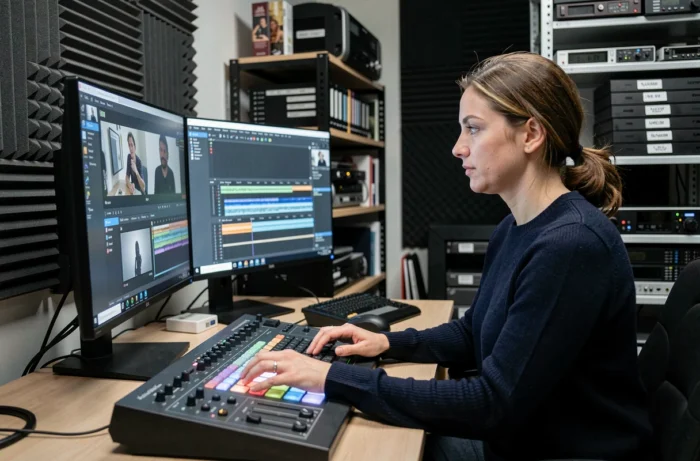
The French audiovisual production is not limited to what appears on screen. Behind every live broadcast, every series filmed in a LED studio, a chain of technical professions orchestrates the capture, transport of streams, and image processing.
With the rise of remote production, cloud technology, and artificial intelligence applied to industrial tasks, a significant part of this value chain is moving off the set. The resulting positions are gaining importance without gaining visibility.
REMI and cloud: the control room leaves the set without warning
The REMI (Remote Integration Model) allows for controlling a production from a remote site, sometimes hundreds of kilometers away from the filming location. The control truck, long a symbol of event production, is gradually giving way to centralized infrastructures connected by fiber or IP networks.
This shift redistributes roles. The technician present on set focuses on raw capture. Mixing, real-time graphics, slow motion, and switching are operated from a technical hub. The streams transit via network protocols such as NDI or ST 2110, which require networking skills absent from traditional audiovisual training.
French service providers specializing in live capture and broadcasting of sports or cultural events, such as Euromedia Télévision, mobilize these distributed architectures for large-scale productions. Mastery of network schematics and stream redundancy becomes a skill as crucial as framing or color grading.
Field reports diverge on one point: the perceived reliability of these remote systems during high-audience live broadcasts. Network latency, even minimal, raises questions of trade-offs between logistical cost and broadcast security.
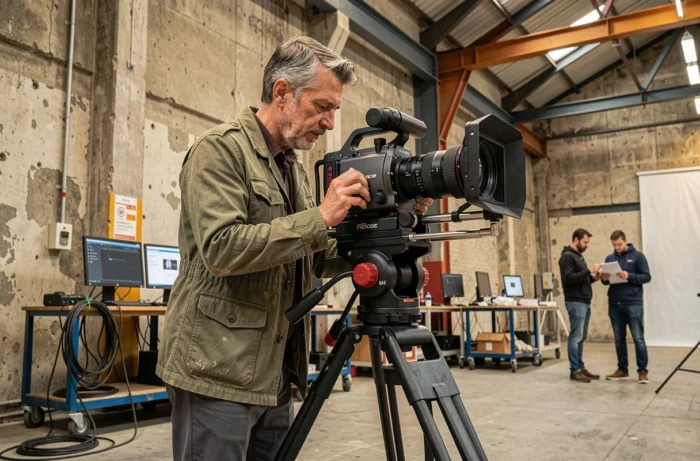
Processive AI in audiovisual production: automated invisible tasks
Generative AI applied to visual effects or editing attracts media attention. Another form of artificial intelligence, less flashy, is more profoundly transforming production flows: processive AI, dedicated to industrial coordination.
In practical terms, this covers shooting planning, document validation (contracts, CNC declarations, payroll for intermittent workers), real-time budget tracking, and optimization of post-production schedules. These tasks previously involved production managers, administrators, and coordinators whose work remained largely invisible.
The partial automation of these functions does not eliminate positions but alters their content. The production manager who spent hours consolidating budget spreadsheets now supervises a tool that generates alerts for overruns. The profession shifts from data processing to decision-making.
What processive AI does not replace
Negotiating with local authorities for filming permits, managing weather-related contingencies on a natural set, communicating with intermittent workers about specific working conditions: these functions remain beyond the reach of current tools. They require contextual judgment that automation does not cover.
Strategic professions in audiovisual integration in France
Recent job offers in the French audiovisual sector reveal a clear shift. The sought-after profiles combine skills that once belonged to separate fields:
- Broadcast system programming coupled with mastery of AVB and Dante networks, audio/video protocols over IP used in sound and broadcast
- Designing schematics for permanent installations (TV studios, conference rooms, event venues) integrating video, sound, and automation
- Preventive maintenance of hybrid systems combining historical analog equipment and recent IP infrastructure
These audiovisual integrator positions are among the most in demand in job postings for 2025-2026, according to data available on specialized job platforms. Their uniqueness: they do not appear in any film credits or sports broadcast credits. The value they produce is structural, not creative.
The paradox is measurable. The more sophisticated French production becomes technically, the more it relies on profiles that the general public, and sometimes the profession itself, struggles to identify. The audiovisual value chain relies on professions that no one sees on screen.

Public funding and digital creation: France 2030 and the CNC as levers
The France 2030 initiative and CNC funding now explicitly target immersive technologies, filming infrastructures, and digital creation. Starting January 1, 2024, the CNC imposes a carbon assessment on any production benefiting from its funding, which has mechanically pushed technical providers to document the environmental impact of their equipment and travel.
These funds direct part of French R&D towards real-time scenography, volumetric capture, and automated video indexing tools.
A French startup ecosystem beyond creation
French expertise in audiovisual production is not limited to studios and channels. A network of startups covers specific links in the chain:
- AI-assisted post-production (color grading, sound cleaning, automated multilingual subtitling)
- White-label SVOD platforms, allowing independent producers to distribute without going through American aggregators
- Real-time tools for event scenography and virtual sets
This ecosystem constitutes an exportable sector advantage, recognized at trade shows like SATIS. The available data does not yet allow for precise measurement of the international market share of these French tools, but their growing presence in European workflows is documented by the specialized press.
French audiovisual production is reconfiguring around hybrid skills, at the intersection of networking, software, and traditional set work. Public funding supports this movement, but the professional recognition of these new roles remains a work in progress. The end credits still do not have a line for the network integrator who made the broadcast possible.