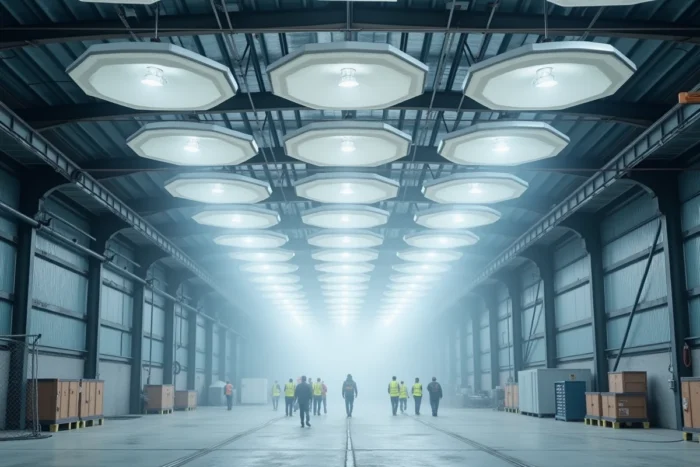
Adiabatic cooling is based on a fundamental physical principle: water that evaporates absorbs heat from the surrounding air, lowering its temperature. When applied to porous ceramics, this mechanism cools the air passing through the material without the need for a compressor or refrigerant. For industrial halls, logistics warehouses, or production workshops, this approach represents a viable technical alternative to the limitations of traditional air conditioning systems.
Pore Structure of Ceramic and Thermal Transfer: The Mechanism in Detail
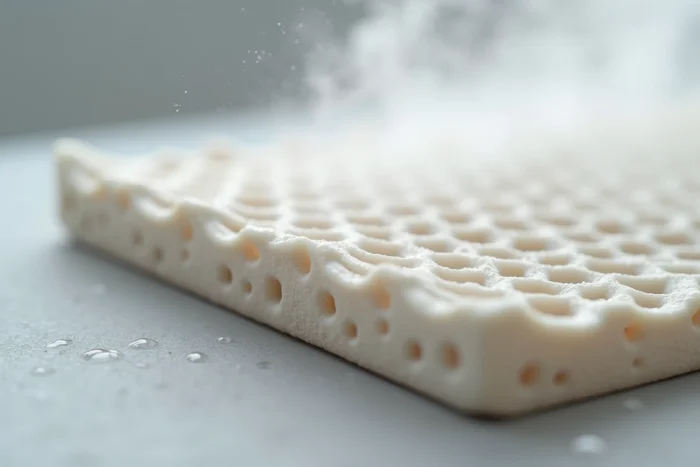
The terracotta used in these devices is not ordinary ceramic. Its controlled microporosity allows water to migrate by capillarity from a reservoir to the surface exposed to the airflow. In contact with this warm, dry air, the water changes phase, transitioning from liquid to gas.
This phase change consumes thermal energy taken directly from the air. The temperature of the air exiting the ceramic medium drops by several degrees, without any electrical input for the cooling process itself. A low-power fan is sufficient to move the air in the largest installations.
The efficiency of this transfer depends on two parameters: the exchange surface area (the larger the wet surface area of the ceramic, the more effective the evaporation) and the humidity of the incoming air. Air that is already saturated with moisture significantly limits the evaporation capacity, which reduces the temperature drop achieved.
To delve deeper into the operation and use cases, ceramic adiabatic cooling is subject to detailed analyses on performance in large volumes.
Direct or Indirect Adiabatic Cooling: Two Approaches for Large Buildings
The most common systems described in online content detail a direct evaporative cooling: air passes through the wet medium, cools down, and then enters the building. The thermal gain is real, but the blown air becomes humid. In a workshop of a few hundred square meters, this increase in humidity can become problematic for certain materials, electronic equipment, or manufacturing processes sensitive to moisture.
Companies like Caeli Énergie in France have recently developed indirect adiabatic cooling systems. The principle: the humidified outside air passes through a heat exchanger but does not come into direct contact with the indoor air. The air blown into the building is cooled without an increase in its humidity level.
This distinction between direct and indirect radically changes the scope of application:
- The direct system is suitable for open or semi-open spaces (warehouses, loading docks, covered markets) where air turnover is naturally high.
- The indirect system targets tertiary buildings, collective residences, or technical rooms where humidity control is an operational constraint.
- Both variants share a significantly lower energy consumption compared to a compressor-based air conditioner, as only a fan and a water circulation pump operate continuously.
Maintenance and Microbiological Risks: The Constraint Manufacturers Rarely Mention
Any stagnant or lukewarm water circuit creates a favorable environment for the proliferation of bacteria, particularly legionella. Ceramic medium adiabatic systems are no exception. The water that soaks the terracotta, the storage tank, and the distribution pipes must be maintained according to a strict protocol.
French health regulations require regular checks of water quality in cooling installations using evaporation. For large buildings, this involves periodic microbiological analyses, water treatment (filtration, disinfection), and cleaning of the porous media to prevent fouling.
Neglecting this maintenance not only jeopardizes the performance of the system. A fouled ceramic medium loses its capillary absorption capacity, and the cooling efficiency collapses. The lifespan of the device directly depends on it.
Climate and Limits of Evaporative Cooling Efficiency
Adiabatic cooling is not universal. Its efficiency closely depends on the local climate. In Mediterranean areas, where summer air is warm and relatively dry, the evaporation potential remains high and the temperature drop significant. In oceanic or tropical climates, the already humid outside air reduces the available cooling margin.
For a warehouse located in southern France, the solution can cover most of the summer thermal comfort needs. For an equivalent building in Brittany, the contribution will be more modest and may require a supplement (mechanical ventilation, air movers).
When Ceramic Is Not Enough
Some industrial contexts require a precise and stable temperature, independent of external conditions. Clean rooms, laboratories, or temperature-controlled food storage areas cannot rely on a system whose performance varies with external humidity. Ceramic adiabatic cooling finds its relevance in large volume spaces where a drop of a few degrees improves working conditions, without the need for temperature control to the tenth of a degree.
- Mechanical or textile production workshops with internal heat generation.
- Exhibition halls, trade shows, and temporary event spaces.
- Covered parking lots, bus stations, or naturally ventilated waiting areas.
The choice between direct ceramic, indirect system, or hybrid solution depends on the climate, type of building, and specific health constraints of each use. Terracotta is not intended to replace traditional air conditioning in all cases, but it offers a concrete response where the energy consumption of a compressor-based system becomes difficult to justify for very large volumes.