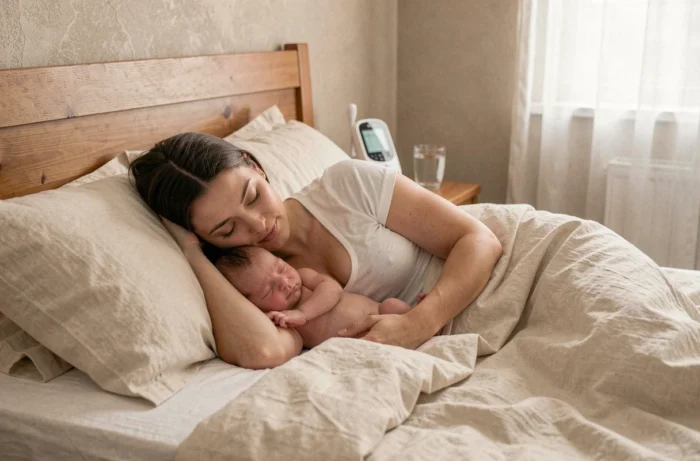
A newborn waking up every two hours, an exhausted parent who ends up falling asleep with them on the couch: it is often in such situations that cosleeping occurs, sometimes without prior thought. It is better to understand what this practice entails, distinguish its forms, and know the concrete precautions to ensure that shared sleep remains safe.
Room-sharing or bed-sharing: two practices, two levels of risk
The term cosleeping (or co-sleeping) encompasses two very different situations. Room-sharing with separate beds involves placing the crib or co-sleeping bed in the parents’ room. Bed-sharing, on the other hand, means that the child sleeps on the same mattress as the adult.
The WHO and the High Authority of Health recommend room-sharing for the first six months. The American Academy of Pediatrics (AAP) goes further since its 2022 update: it advocates for room-sharing without bed-sharing for at least six months, ideally up to twelve months. This extended window corresponds to the period when the risk of sudden infant death syndrome gradually decreases.
Bed-sharing, however, remains discouraged by most health authorities. Research conducted in the United States on over eight thousand infant deaths identified bed-sharing as a risk factor, especially when associated with other unfavorable conditions. We will return to this later, as it is where daily safety is at stake. To explore the different possible configurations, there are cosleeping resources on Puériculture Bébés that detail each sleeping option.

Side-car co-sleeping bed: the equipment that changes the night
The side-car co-sleeping bed attaches to the parents’ bed with one side open. It allows for physical contact with the infant, enabling the parent to place a hand on them, reassure them, or breastfeed without getting up, while maintaining separate sleeping surfaces.
What to check before buying
- The height of the co-sleeping bed mattress must align exactly with that of the parents’ mattress, without any gap or space between the two. A gap of just a few centimeters can create a trap for the baby’s face.
- The mattress of the co-sleeping bed must be firm, flat, and fit the frame dimensions. Inclined or padded devices have been banned for sale in the United States since the Safe Sleep for Babies Act of 2022, and European authorities are tightening their stance on these products.
- The attachment system to the parents’ bed must prevent any tipping or separation. Test the sturdiness by pushing the bed laterally before each night during the first weeks.
- No pillows, blankets, bumper pads, or stuffed animals in the infant’s sleeping space. The rule is simple: a bare mattress, a fitted sheet, a sleep sack.
This type of bed is available in most baby product stores. Feedback varies on the actual duration of use, as many models become too small around five or six months.
Cosleeping and nighttime breastfeeding: a direct link on the ground
Physical proximity at night concretely facilitates feedings. There is no need to get up, turn on the light, or move the baby. The infant shows hunger signals earlier (sucking movements, slight agitation), and breastfeeding occurs before they start crying loudly.
This mechanism has a documented effect: room-sharing promotes longer breastfeeding. Fewer full awakenings for the mother, less stress for the child, and sleep cycles that eventually partially synchronize between the breastfeeding parent and the infant.
From a hormonal perspective, nighttime skin-to-skin contact stimulates the production of prolactin, the lactation hormone. Breastfeeding is also considered, according to medical literature, a protective factor against sudden infant death syndrome, reinforcing the rationale for room-sharing in the early months.

Safety conditions for cosleeping: non-negotiable contraindications
The general recommendations are well known (no duvet, no pillow, baby on their back). What is less often detailed are the absolute contraindications to bed-sharing, even accidental.
- Smoking by one of the parents, even if the person does not smoke in the room. Residual exposure alters the infant’s respiratory reactivity.
- Consumption of alcohol, sleeping pills, or any medication that impairs alertness. Just one drink is enough to reduce the ability to perceive the baby’s movements during sleep.
- Prematurity or low birth weight. These infants have an increased vulnerability to respiratory obstructions.
- Inappropriate sleeping surface: couch, armchair, water mattress, very soft mattress. The couch is the most dangerous surface to fall asleep with a baby, with a significantly higher risk of entrapment between cushions compared to a bed.
When one is so tired that they can fall asleep anywhere, it is better to prepare a secure space in advance (co-sleeping bed ready, crib within reach) rather than end up on the couch with the infant by default.
When to stop cosleeping: spotting transition signals
Most families practicing room-sharing notice a change around six months. The baby starts to roll over, crawl, and sometimes stand up in the bed. These motor skills make the side-car co-sleeping bed potentially dangerous if the barriers are not appropriate.
The AAP places the end of the recommended room-sharing window between six and twelve months. Beyond that, the protective benefit decreases and the transition to a separate room can be gradual, starting with naps and then shifting nighttime sleep.
A child who sleeps well in the parents’ room does not need to be moved on a fixed date. The relevant signal is rather the sleep quality of each: when mutual awakenings become more frequent than the benefits of proximity, it is time to consider the change.