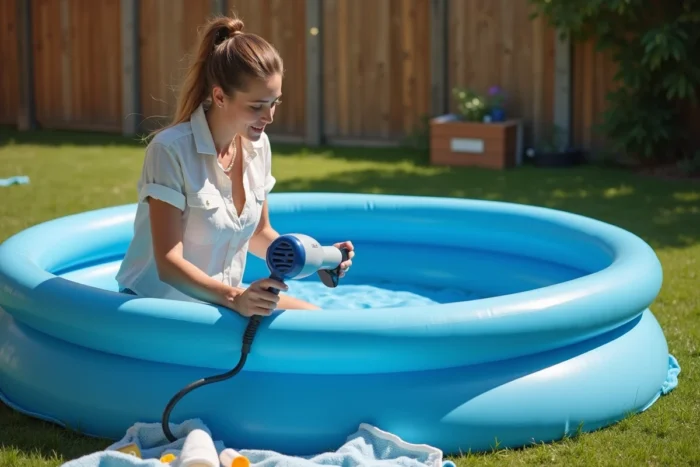
A hairdryer produces a sufficient airflow to fill the rings of an inflatable pool in just a few minutes, provided you direct this flow towards the valve. The technique is based on a simple principle: create a tight connection between the air outlet of the device and the pool’s inflation opening, without ever using the heat function.
Hairdryer Settings: Cold Air and Maximum Flow
The first parameter to master is the temperature. Use only the cold air mode, often indicated by a snowflake or the word “cool” on the device. The PVC of inflatable pools deforms under heat, and prolonged hot airflow can weaken the seams of the rings.
Even recent models equipped with intelligent temperature control are not designed to operate with an air outlet partially obstructed by an adapter. The sensor regulates heat based on the scalp, not based on a plastic tube. Forcing the device into this configuration can trigger internal overheating that the safety system does not properly detect.
Set the flow to maximum power. The higher the volume of air propelled, the faster the inflation will be. Before inflating a pool with a hairdryer, ensure that the intake grilles at the back of the device are not blocked by dust, which would reduce airflow and increase motor heating.
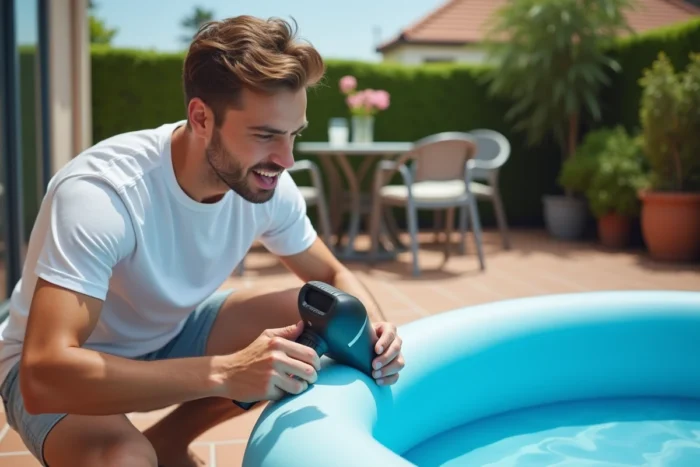
Creating a Tight Connection Between the Nozzle and the Valve
The main difficulty is not the power of the device, but the tightness of the connection between the air outlet and the inflation valve. Without an adapter, air disperses around the opening and the ring does not fill.
Method with a Plastic Bottle
Cut the bottom off a standard plastic bottle. The neck fits into the pool’s valve, while the open side fits over the hairdryer nozzle. Secure each joint with wide tape to limit air leaks.
The diameter of the neck corresponds to most standard inflatable pool valves. If the valve is wider, wrap several layers of tape around the neck to thicken the connection and fill the gap.
Method with a Flexible Hose
A piece of garden hose or washing machine drain hose also works. The internal diameter must be narrow enough to create pressure at the valve entrance. Tape one end to the hairdryer nozzle and push the other into the valve.
This method offers more flexibility for reaching valves located close to the ground, where it would be difficult to keep the hairdryer stable with a rigid bottle.
- Plastic bottle: quick connection, ideal for standard diameter valves, but fragile if the tape comes loose
- Flexible hose: more versatile and easier to direct, suitable for larger pools with multiple rings
- Wide tape (such as duct tape): prefer it over thin tape that tears under air pressure and does not stick to curved surfaces
Precautions to Avoid Damaging the Pool or the Hairdryer
Never inflate the rings to their maximum capacity with this technique. The air propelled by a hairdryer enters faster than with a manual pump, and the pressure can rise without visible deformation of the PVC. Stop inflating when the ring feels firm to the touch but is still slightly soft under finger pressure.
Take regular breaks to allow the motor of the device to cool down. A hairdryer is designed to operate for a few minutes continuously, not to run for a quarter of an hour without interruption. Alternate a few minutes of inflation with a minute of rest to avoid burning out the motor.
Another point to watch: water. Never place the hairdryer on a wet surface and keep it away from the pool if it already contains water. The device remains plugged in during the entire operation, and the electrical risk is real in a humid environment.
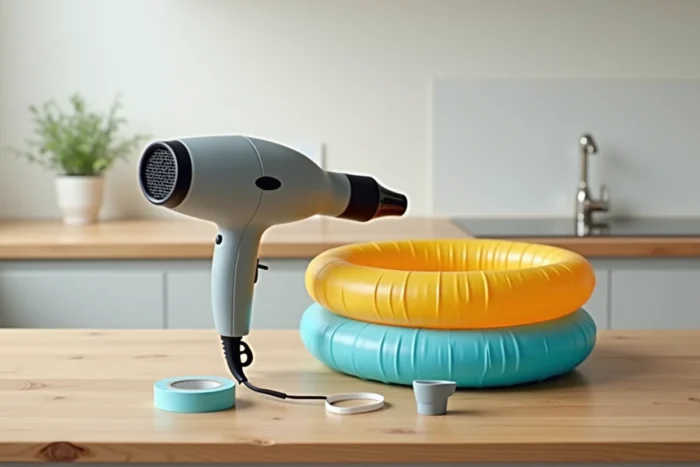
When the Hairdryer Is Not Enough: Limits and Alternatives
This technique works well for small to medium-sized inflatable pools, those whose main ring goes around the pool. For family models with multiple separate air chambers, the inflation time increases significantly, and the hairdryer may overheat before finishing.
An electric pump remains more suitable for larger pools. These devices produce comparable airflow, but their motors can handle prolonged operation and their nozzles fit directly onto the valves without any DIY work.
For inflatable spas, the question does not arise: these units have their own inflation system via the motor block. Attempting to inflate a spa with a hairdryer would be ineffective due to the volume of air required and the specific valves.
- Children’s pool (modest diameter): the hairdryer is sufficient, expect a few minutes per ring
- Family pool (multiple rings): feasible but lengthy, with mandatory breaks for the motor
- Inflatable spa: the hairdryer is not a viable option, the integrated motor block is the only intended method
The hairdryer effectively serves as a backup when no pump is available, provided two rules are followed: cold air only, and a well-secured connection. For repeated use every summer, investing in a small electric pump with universal nozzles will prevent overworking a device not designed for this purpose.