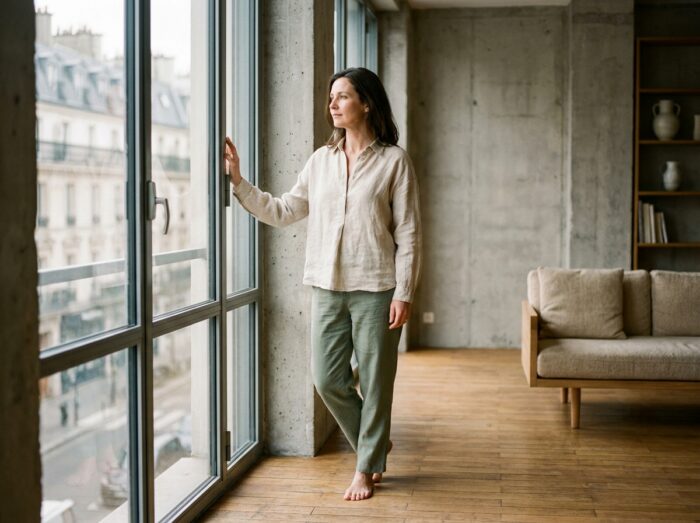
You have probably already felt the difference between a north-facing room, a bit dull even in the middle of the afternoon, and a living room flooded with sunlight from the morning. This sensation is not anecdotal. Natural light directly affects sleep, mood, and energy levels throughout the day. Understanding how it works in a home allows for concrete layout choices, far beyond just the size of the windows.
Circadian rhythm and sunlight: what happens in the body
The human body does not react to light like an on/off switch. It follows a cycle of about 24 hours, called the circadian rhythm, which regulates the wake-sleep alternation. Sunlight, captured by specific receptors in the retina, sends a signal to the brain to slow down the production of melatonin, the sleep hormone.
In the morning, exposure to sufficiently intense light helps to set this rhythm. Recent studies show that people receiving more light early in the day have more sustained daytime activity, less fragmented wake periods, and better subjective sleep quality.
It is not the total amount of light received that matters, but the timing of its arrival. A very bright room at noon but dark in the morning does not offer the same benefit as a space that captures sunlight from the early hours. Placing the bedroom or breakfast nook on the east side significantly changes how the day begins.
A roller blind that is well chosen allows you to modulate incoming light according to the time, letting in the maximum in the morning and then filtering the rays as the heat rises.
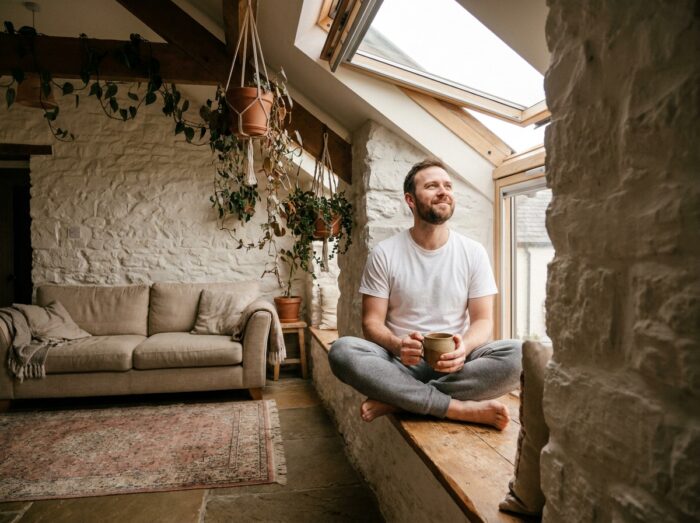
Natural light during the day, darkness in the evening: a two-part scenario
Have you ever noticed that after an evening spent in a brightly lit living room, falling asleep takes longer? Natural light must be considered alongside evening darkness, not just daytime brightness. Intense light in the evening, even artificial, can delay melatonin secretion and disrupt sleep consolidation.
The challenge in a home is therefore not to increase light at all times. It is to create an evolving lighting scenario:
- In the morning and during the day, favor bright and cool light (high color temperature) by fully opening solar protections and allowing the sun to enter living spaces.
- In the late afternoon, start to dim incoming light with blinds or sheer curtains to soften the transition.
- In the evening, reduce overall light intensity and favor warm, low-intensity sources in lux to prepare the body for sleep.
This simple principle transforms the perception of an interior. A house that respects this light rhythm does not provide the same sense of comfort as an apartment uniformly lit from morning to night.
Skylights and summer overheating: the trap of zenithal light
Installing a skylight seems to be the ideal solution for flooding a space with natural light. And it is true: zenithal light, which comes from above, illuminates a room more evenly than a traditional facade window.
But this orientation also exposes rooms to summer solar gains. Without movable solar protection, a skylight can turn a bedroom into a sauna as early as June. Under the RE2020 framework, construction projects must also combine zenithal light with effective protection devices to limit summer thermal discomfort.
Specifically, if you are considering a skylight or a roof lantern, plan for an external blind or shutter from the design stage. Natural light is only valuable if it remains manageable. An influx of light that cannot be reduced becomes a nuisance, not an advantage.
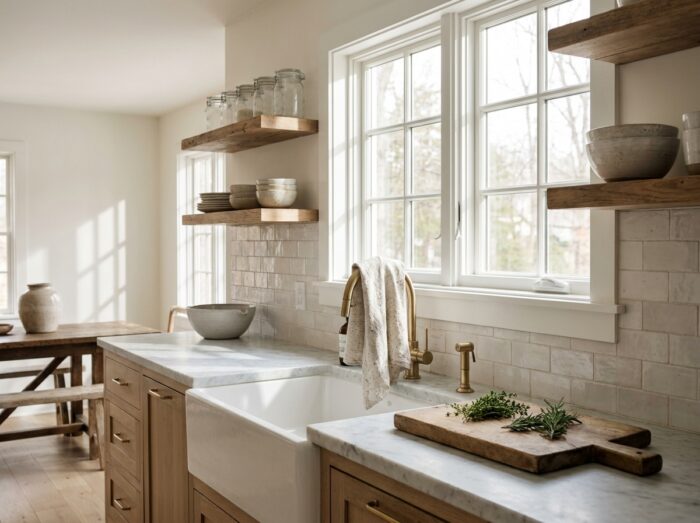
Wall color and perceived intensity: amplifying light without heavy work
Before drilling an additional opening, there are simple levers to improve the diffusion of natural light in a room. The color of interior surfaces plays a direct role in the perceived light intensity.
A light wall reflects sunlight, while a dark wall absorbs it. A living room painted in off-white or a light shade can appear significantly brighter than an identical space in dark gray, with equal glazing area. The floor also matters: a light wood floor or matte tile reflects light back towards the ceiling and opposite walls.
Here are some concrete interventions to consider:
- Replace opaque curtains with sheers that let light in while preserving privacy.
- Position a mirror facing a window to reflect light towards the back of the room.
- Choose furniture with light or satin surfaces rather than dark matte finishes that absorb light.
These adjustments do not replace good orientation of the home, but they optimize what already exists. Working on light reflection costs less than enlarging a window.
Mood, work, and health: why natural light is not a luxury
Sunlight directly influences the production of serotonin, a neurotransmitter linked to mood regulation. A dark interior during the day does not just cause visual discomfort. It can contribute to decreased energy, difficulty concentrating, and, over time, affect overall well-being.
For remote work, placing a desk facing the window (or perpendicular to it, to avoid glare on the screen) makes a measurable difference in the ability to stay focused for several hours. Natural light at the workstation reduces eye strain and maintains alertness.
Light therapy, often associated with specific lamps delivering high intensity in lux, is based on the same principle: compensating for a lack of sun exposure. But in a well-designed home, this compensation becomes less necessary. Orienting living spaces to the south or southeast, properly sizing openings, and planning for movable protections for summer constitutes the best form of natural light therapy.
Natural light at home is not a matter of decoration or trend. It is a physiological parameter that conditions sleep, alertness, and mood on a daily basis. The choices made at the design stage of the home, or during a renovation, determine the quality of life for years.