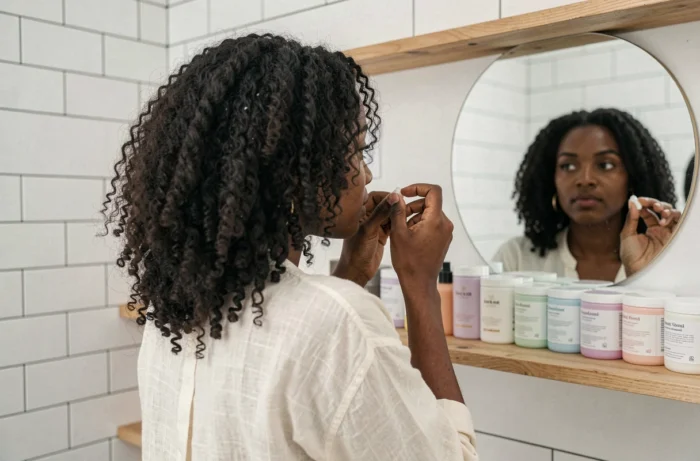
Clean formulations for curly hair have reached a technical plateau. Gentle surfactants, sulfate-free bases, and plant-based moisturizing actives are now a standard, not a marketing argument. The real issue in 2026 is the ability of these styling creams to meet the demands of challenging hair profiles, particularly fine or low-porosity curls, where most clean formulas show their limits.
Clean styling cream and fine curly hair: the issue of lipid overload
Fine, low-porosity curly hair accumulates oils on the surface without absorbing them. Shea butters and heavy oils (castor, avocado), ubiquitous in clean creams aimed at curls, weigh down the fiber and crush the bounce within hours. The result: flat curls, a greasy appearance by the second day, and nonexistent volume.
We observe that brands formulating for this hair profile are leaning towards water-dominant emulsions, with light humectants (low-concentration vegetable glycerin, aloe vera) and non-occlusive film formers. The challenge remains to maintain sufficient hydration without leaving a perceptible residue to the touch.
To delve deeper into this topic, a detailed analysis of clean styling cream on Beauté en Folie lists recent formulas attempting to solve this equation.
The selection criterion to remember: a clean cream suitable for fine curls contains neither butter nor oil among its first five ingredients. If the INCI list starts with a butter or a vegetable oil, the product is aimed at thick or high-porosity hair.

Hybrid care-styling textures: gel-cream and jelly cream for curls
The styling cream of 2026 is no longer an isolated definition product. Hybrid formats (gel-cream, jelly cream, whipped cream) merge hydration, protection, and hold in a single step. This evolution responds to a concrete demand: to reduce the number of layered products that contribute to a cardboard effect on curls.
How gel-cream texture changes curly fiber
A well-formulated gel-cream leaves a flexible film that maintains definition without stiffening the curl. The difference with a classic gel lies in the absence of high-hold synthetic polymers. The finish remains adjustable after drying, allowing you to break the cast (the gel crust) without losing shape.
Jelly creams, being lighter, are suitable for wavy and 2C-3A curls that cannot handle the density of a rich cream. Their gelled aqueous base provides surface hydration without migrating oils to the scalp.
Formulation criteria to check
- Aqueous phase first, followed by a natural gelling agent (xanthan gum, hydroxyethyl cellulose) for flexible hold
- Absence of water-insoluble silicones, which require a clarifying shampoo and contradict the co-wash logic
- Presence of a moderate humectant (glycerin below 5% in the formula) to avoid a sticky effect in humid weather
- No microcrystalline wax or paraffin, which block atmospheric hydration on medium-porosity hair
Clean hair routine in 2026: adapting the protocol to curl type
The universal approach is over. Recommendations vary significantly between fine wavy hair and thick coily hair, even within the same clean range. We recommend segmenting the routine into three axes: cleansing, deep care, styling.
Co-wash remains relevant for tight curls (3B and beyond), but wavy and loose curls accumulate more sebum at the roots. A gentle sulfate-free shampoo, used once or twice a week, prevents the “heavy hair” effect that co-wash alone can cause on these textures.
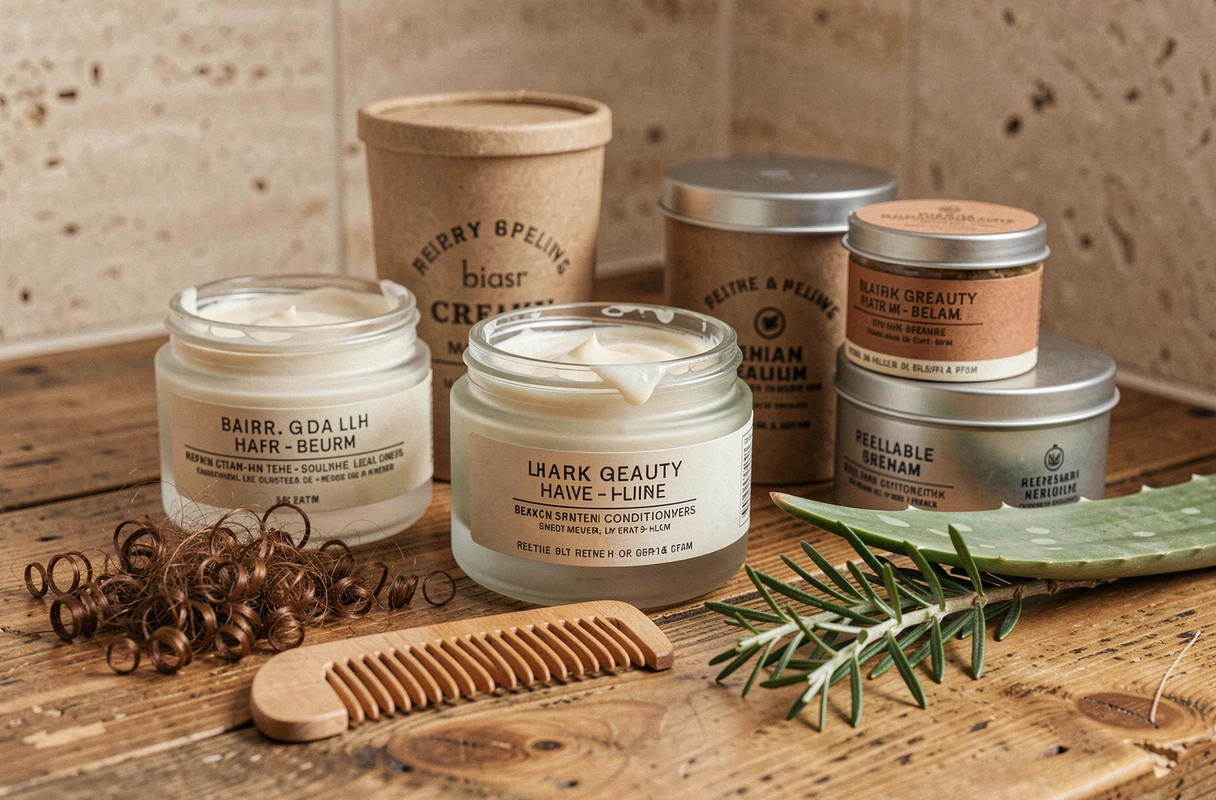
For deep care, masks based on fractionated coconut oil or hydrolyzed rice proteins strengthen the fiber without weighing it down. The proteins temporarily rebuild keratin degraded by heat or coloring, a point often overlooked by 100% hydration routines.
Styling sequence according to porosity
On low-porosity hair, applying styling cream to very wet (not towel-dried) hair allows the actives to penetrate before the cuticles close. On high-porosity hair, applying to slightly towel-dried hair limits product dilution and improves hold.
This distinction may seem minor, but it radically changes the final result. The timing of application matters as much as the formula itself.
Residue-free definition: the criterion that distinguishes clean creams in 2026
The search for a natural, flexible finish without visible deposits dominates expectations. Formulas that leave white residues or a sticky film are losing ground to transparent, fast-absorbing textures.
French brands specializing in curls (Les Secrets de Loly, Curly Mood) are directing their developments towards creams with high water content, featuring concentrated actives but in low percentages. The principle: little material deposited, but well-targeted on the cuticle.
- Creams enriched with honey or propolis provide natural shine without a greasy effect, suitable for medium to thick curls
- Formulas based on aloe vera and flax are better suited for fine curls that saturate quickly
- Custards (thick creams made from gelled flax seeds) offer maximum definition on coily hair but weigh down fine textures
The clean market for curls is no longer just about the absence of controversial ingredients. The real differentiation lies in a formula’s ability to define without weighing down, hydrate without greasing, and hold without freezing. Fine and low-porosity curls remain the most demanding test for formulators, and creams that pass this filter work on all other hair profiles.