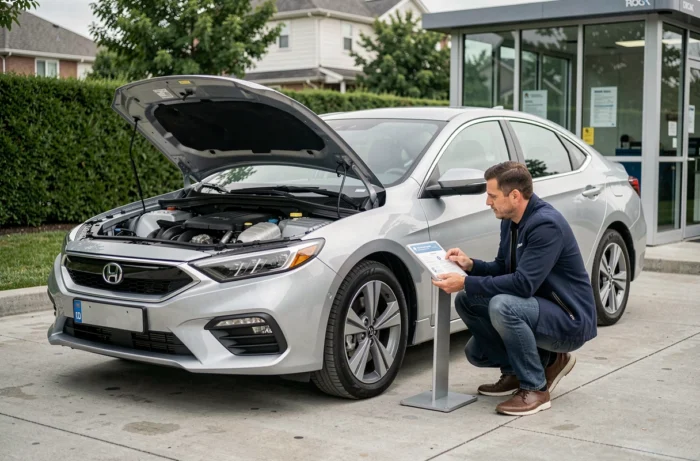
A hybrid car combines a thermal engine, usually gasoline, and one or more electric motors powered by an onboard battery. This dual propulsion system reduces fuel consumption by utilizing electric energy during phases when the thermal engine is least efficient, particularly during startup and at low speeds.
Kinetic energy recovery: the central mechanism of hybrids
The operation of a hybrid car is based on a principle often underestimated: energy recovery during braking. When the driver lifts their foot off the accelerator or brakes, the electric motor reverses and acts as a generator. It converts the vehicle’s kinetic energy into electricity, which is stored in the battery.
This recovery cycle creates an energy loop that the thermal engine alone cannot replicate. In urban settings, where braking and deceleration phases are frequent, this recovery powers the electric motor for subsequent restarts. The thermal engine remains off during these short sequences, eliminating fuel consumption while stationary and during startup.
An onboard computer manages the distribution between the two propulsion systems in real time. It analyzes speed, battery charge, and accelerator pressure to decide which engine to engage. The driver does not intervene in this management: the transition between electric mode and thermal mode occurs automatically.
To delve deeper into the definition of a hybrid vehicle on Cariboost, the principle remains the same regardless of the manufacturer: to exploit every phase of driving to enhance the overall efficiency of the vehicle.
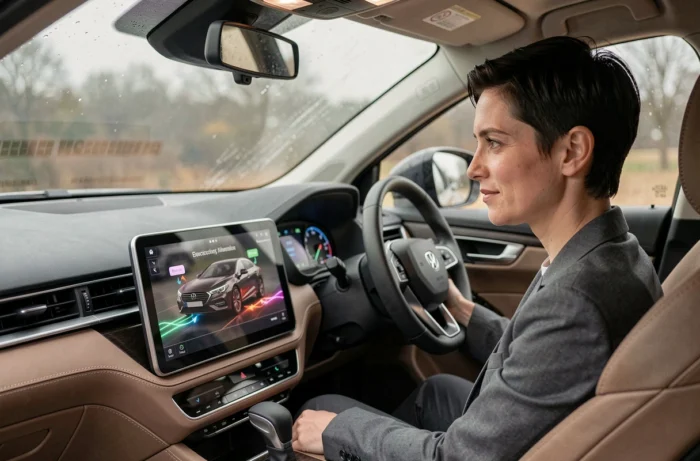
Simple hybrid, mild hybrid, plug-in hybrid: what really distinguishes them
The term “hybrid” encompasses three technical architectures with very different uses. Confusing them can lead to purchasing mistakes.
- The mild hybrid uses a low-power electric starter-generator. It cannot propel the vehicle on its own. Its role is limited to assisting the thermal engine during acceleration and shutting off the engine when stationary. The fuel savings are modest.
- The full hybrid (simple hybrid or HEV) has an electric motor capable of moving the vehicle alone for a few kilometers at low speed. The battery is recharged only through energy recovery and via the thermal engine. No external charging socket is needed.
- The plug-in hybrid (PHEV) features a larger capacity battery, rechargeable from a household outlet or charging station. It offers several dozen kilometers in 100% electric mode before the thermal engine takes over.
The full hybrid is suitable for drivers who frequently drive in the city without wanting to manage charging. The plug-in hybrid makes sense when daily trips are short and a charging point is accessible at home or work. Without regular charging, a PHEV consumes as much, if not more, than a full hybrid due to the additional weight of its battery.
Market share of hybrids in Europe: the dominant powertrain in 2025-2026
Non-rechargeable hybrids have become the best-selling powertrain among new cars in the European Union. According to an analysis by ACEA reported by Ecomotors News in August 2026, HEVs accounted for about 37% of new registrations in the first half of 2026, ahead of pure thermal engines and 100% electric vehicles.
This shift changes the perspective. Hybrid technology is no longer a marginal transitional technology: it is the standard in the European new car market. Mainstream manufacturers now offer a hybrid version across nearly all their ranges.
Plug-in hybrids are also experiencing a marked rebound. According to the Eurostat report of July 31, 2026, PHEV registrations increased by about one-third in 2025 compared to 2024, reaching a record level in the EU. This resurgence is partly explained by improvements in electric ranges and access restrictions in low-emission zones (LEZ).
Access to LEZ and Crit’Air sticker: a concrete regulatory advantage
In France, low-emission zones affect a growing number of urban areas. Older thermal vehicles are gradually banned from circulation based on their Crit’Air sticker.
Hybrid cars (HEV and PHEV) generally receive a Crit’Air 1 sticker, which guarantees access to all currently established LEZ. Recent plug-in hybrids may even qualify for a Crit’Air 0 sticker if they operate in electric mode in the relevant areas, depending on local regulations.
This regulatory aspect significantly influences vehicle choice. A driver who regularly traverses a city with a LEZ avoids traffic restrictions and potential fines. For a thermal vehicle classified as Crit’Air 3 or higher, the ban on circulation in these zones is already in effect in several French cities.
Real operating cost of a hybrid car: beyond the purchase price
The additional cost of purchasing a hybrid model compared to its thermal equivalent varies by range, but it is partially offset over time by reduced fuel consumption. In urban and suburban driving, a full hybrid consumes significantly less than a conventional gasoline engine due to electric driving phases.
Mechanical maintenance also shows differences. The braking system wears less quickly on a hybrid because regenerative braking reduces the strain on pads and discs. The transmission, often continuously variable (CVT) or planetary gear, does not include a conventional clutch that needs replacing.
The hybrid battery (NiMH or lithium-ion) is designed to last the entire life of the vehicle in most cases. Manufacturers generally guarantee it for a long duration and high mileage. Its replacement is rare and does not constitute a regular expense.
The choice between simple hybrid and plug-in hybrid depends on the driving profile. A PHEV charged daily on the commute significantly reduces energy costs. The same PHEV used exclusively on the highway without ever being plugged in loses all its advantage compared to a lighter HEV.