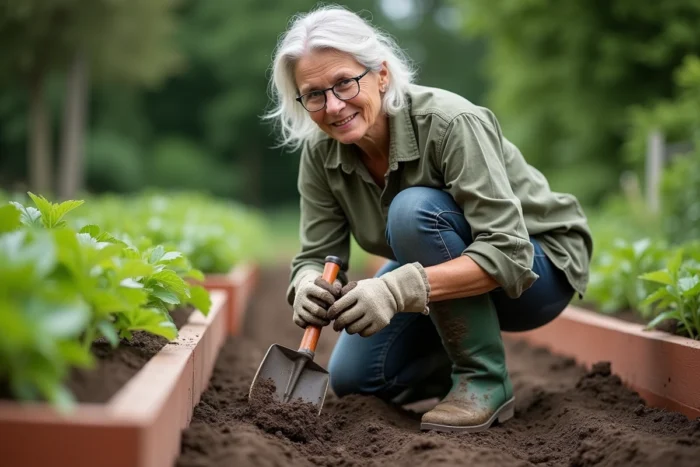
The hoe and the stirrup hoe are two hand gardening tools designed to work the top layer of soil. Their main function is identical (breaking the soil crust, cutting weeds at the collar), but their geometry differs enough that the choice between the two affects posture, effort, and results in the vegetable garden.
Blade and head: understanding the geometry of each gardening tool
The hoe consists of a flat, rectangular or trapezoidal blade fixed perpendicularly to the handle. This single blade works by pulling or pushing, depending on the angle of attack. The tool excels on flat and clear surfaces, where the motion can remain close to the ground.
The stirrup hoe combines two distinct blades mounted on either side of the socket. The most common configuration combines a head (small flat blade) and a tongue (narrow and pointed blade). This dual head allows for transitioning from hoeing to opening furrows without changing tools.
The tongue of the stirrup hoe penetrates the soil deeply to create a seed furrow or clear the base of a plant. The head, being wider, is used to bring soil back, mound, or weed at the surface. Understanding the function of hoe or stirrup hoe and their use allows for adapting the motion to the required work rather than forcing with an unsuitable tool.
A hoe with a wide blade is better suited for the generous interrows of a rowed vegetable garden. The stirrup hoe, thanks to its tongue, can maneuver between closely spaced plants or in a dense flower bed. The choice therefore depends as much on the arrangement of the crops as on the type of soil.
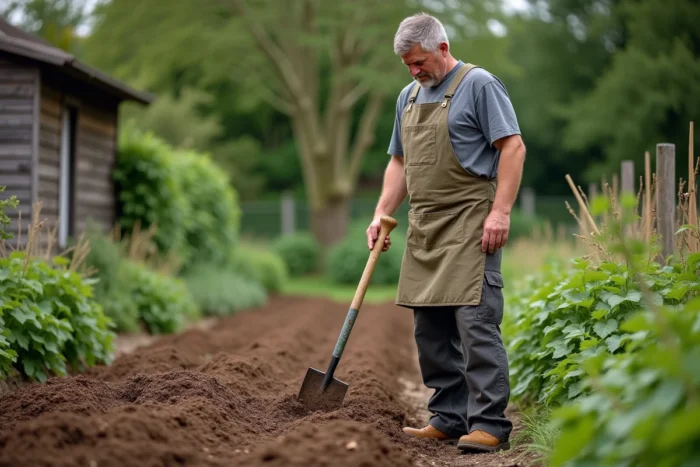
Hilling and water conservation: why hilling partially replaces watering
The old adage “one hilling is worth two waterings” is based on a simple physical mechanism. When the soil dries on the surface, it forms a compact crust with micro-capillaries. Water rises through these capillaries and evaporates. Breaking this crust by hilling interrupts the capillary rise and maintains moisture deeper in the soil.
With the increasing frequency of intense heat episodes and watering restrictions, this technique is becoming a concrete lever for water conservation in the garden. Several professional gardeners have been recommending for a few years to systematically hill after every significant rain or watering, rather than watering twice as much.
The flat hoe is the most effective tool for this surface hilling. The motion involves scraping the top two or three centimeters of soil, without going deeper. The stirrup hoe can also be used, utilizing the head, but its tongue risks going too deep and damaging shallow roots if the motion lacks control.
Handle ergonomics and pain prevention in the garden
The blade is not everything. The handle affects posture and determines whether gardening remains a pleasure or becomes a source of lower back pain. A handle that is too short forces one to bend their back constantly. A handle that is too long reduces the precision of the motion.
The appropriate length can be easily checked: standing with hands on the handle, the elbows should remain slightly bent without the back arching. For most body types, this corresponds to a handle reaching between the sternum and the chin.
In recent years, several manufacturers have offered ranges with curved handles and soft grip handles designed to reduce musculoskeletal disorders. These ergonomic adaptations, inspired by occupational risk prevention standards, truly change the comfort of use during extended weeding sessions.
- A wooden handle (ash or beech) absorbs vibrations better and remains pleasant in cool weather, but requires annual oiling to prevent splitting.
- A fiberglass or composite handle resists moisture and impacts without maintenance, with a slightly lower weight.
- Ergonomic elastomer grips distribute pressure on the palm and limit blisters during regular use.
Tool maintenance: steel, rust, and sharpening the blade
A dull blade requires more effort. The blade of the hoe and the head of the stirrup hoe can be sharpened with a few passes of a flat file, respecting the original bevel angle. Regular sharpening halves the effort of hilling.
After each use, wiping the blade with a dry cloth is enough to remove moist soil. At the end of the season, a more thorough cleaning followed by a thin layer of linseed oil on the metal prevents rust from setting in during winter.
The quality of the steel makes a difference over time. A hardened steel blade retains its sharpness longer than ordinary steel. When purchasing, the weight of the blade gives a clue: an abnormally light tool often uses thin sheet metal that bends during use in clay or stony soil.
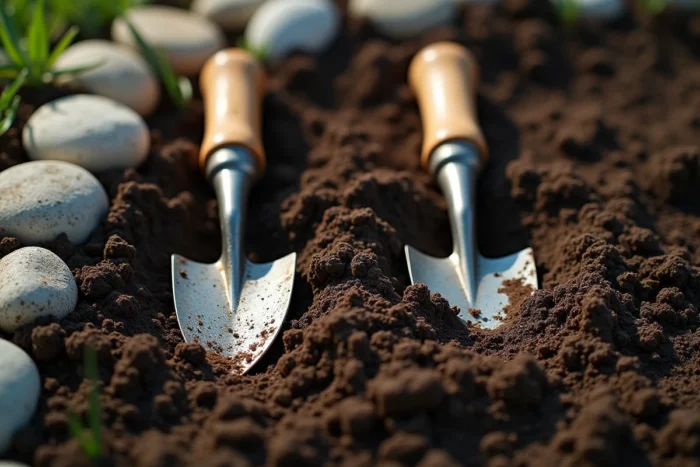
Choosing between hoe and stirrup hoe based on soil type and planting density
The final choice boils down to two intersecting criteria: soil nature and planting density.
- On loose, sandy soil with spaced rows, the flat hoe offers quick and even work. Its wide blade covers more surface in a single pass.
- On clayey or compact soil, the stirrup hoe with its pointed tongue penetrates the hard crust better and allows for creating seed furrows without excessive effort.
- In a square vegetable garden or a dense flower bed, the stirrup hoe wins due to its versatility: the tongue works at the base of plants, while the head brings soil back or mounds vegetables.
For a versatile garden, having both tools remains the most functional combination. The hoe is used for quick weeding of paths and large areas. The stirrup hoe takes over for precision work, opening seed lines, and hilling.
The material of the blade, the length of the handle, and the frequency of sharpening matter more than the brand on the label. A well-sized tool, kept sharp and used with correct posture, covers the vast majority of hilling and weeding tasks in the garden.