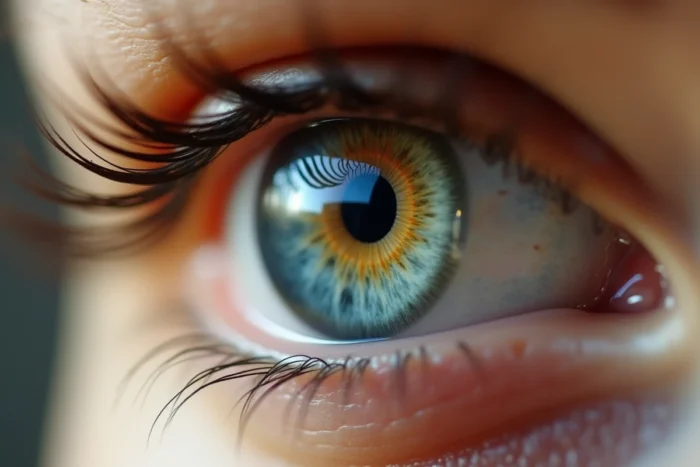
When you look closely at someone’s iris under natural light, you discover a mix of blue, green, and gray, with a golden or yellow ring around the pupil. The question arises quickly: is this normal, what is it called, and should one consult? This phenomenon has a specific name in ophthalmology and is explained by the distribution of pigments in the iris.
Yellow ring around the pupil: the role of melanin in the iris
When observing a light iris (blue, gray, or green) with a yellow-golden circle surrounding the pupil, you are looking at an uneven distribution of melanin in the iris. Melanin is the dark brown pigment that determines the color of the eyes, skin, and hair. The higher its concentration in the iris, the darker the eye appears.
In a light iris, the concentration of melanin remains generally low. The central yellow or golden ring indicates a zone where pigmentation is more concentrated, just around the pupil. Another pigment, lipofuscin, may also play a role: this yellowish substance mixes with melanin and enhances the golden color of the center of the iris.
Specifically, the anterior layer of the iris (the stroma) contains varying amounts of melanin depending on the areas. When the stroma is lightly pigmented at the periphery but more concentrated around the pupil, you get this contrast between a blue-gray-green iris and a yellow or amber center. A person with blue-green-gray eyes and yellow simply has a heterogeneous pigment distribution, not a pathological anomaly.

Central heterochromia: the term that describes this ring in the iris
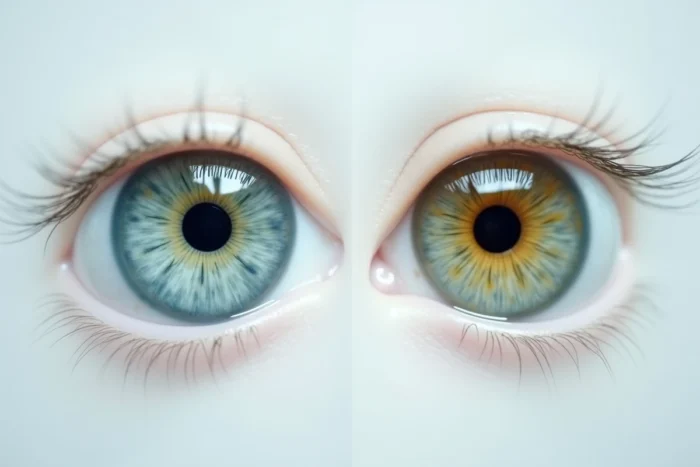
This phenomenon has a clinical name: central heterochromia. We refer to heterochromia whenever the color varies within the iris or between the two eyes. Central heterochromia specifically refers to a different color around the pupil compared to the rest of the iris.
It should not be confused with the limbal ring, which is located at the boundary between the iris and the white of the eye (the sclera). The limbal ring forms a dark circle at the outer edge of the iris. Central heterochromia, on the other hand, is located inside, just around the pupil.
Differences between central heterochromia and other forms
- Complete heterochromia: each eye has a different color (one blue eye, one brown eye, for example). This is the most visible and well-known form.
- Sectorial heterochromia: a portion of the iris (a “quarter”) has a color distinct from the rest, like a brown spot on a green iris.
- Central heterochromia: the ring around the pupil has a different color from the rest of the iris. This is the most common form in light eyes with a golden or yellow center.
In the vast majority of cases, central heterochromia is congenital and benign. It is determined by genetics, although the precise mechanisms remain complex: at least 16 genes are involved in iris color.
Why does eye color seem to change depending on the light?
We are often told “your eyes are blue” one day and “rather green” the next. This is not an illusion. An iris that combines several pigments in low concentration reacts strongly to lighting conditions.
Under direct natural light, short wavelengths (blue) are more scattered by the lightly pigmented stroma, giving a bluish or grayish dominant. In warm artificial light, the central yellow appears more pronounced and shifts the overall color towards green or hazel. The environment also plays a role: a green sweater or a white wall alters the perceived reflections.
The same iris can appear gray, green, or blue depending on the angle and light, without any physiological change occurring. This is a purely optical effect related to the diffusion of light in a lightly pigmented stroma.
Should you consult an ophthalmologist for a yellow ring in the iris?
Most of the time, the answer is no. Stable central heterochromia, present since childhood, does not require special monitoring. You notice it, understand it, and move on.
However, certain situations warrant medical advice:
- A recent change in iris color in an adult, especially if it affects only one eye
- A yellowish ring that gradually appears at the periphery of the iris (and not at the center), as it may indicate a corneal arc or, in rare cases, a metabolic disease
- A change in vision, pain, or light sensitivity accompanying the color change
A stable central yellow ring since childhood is almost always benign. It is a sudden or unilateral change in adulthood that deserves a consultation. Feedback on this point varies among practitioners, but the consensus remains clear: stability over time is the reassuring criterion.
If you simply want to check the nature of your iris color, an examination with a slit lamp at the ophthalmologist’s office is sufficient. The examination lasts a few minutes and allows you to distinguish between ordinary central heterochromia and abnormal pigment deposits.
An iris that mixes blue, green, gray, and yellow with a golden central ring mainly tells the genetic story of ocular pigmentation. It is neither a mystical sign nor a cause for concern, but one of the most common variations among people with light eyes. The only useful reflex is to monitor any recent changes and to enjoy the rest as an anatomical curiosity rather well carried.