
A quarter of a liter corresponds to 25 centiliters, or 250 milliliters. This equivalence is based on the decimal metric system: 1 liter is divided into 100 centiliters, and the fraction 1/4 gives 100 ÷ 4 = 25 cl. Knowing how to convert this measurement allows you to adapt any recipe to the available utensil, from a measuring cup to a simple tablespoon.
Why 25 cl does not always weigh 250 g depending on the ingredient
Many recipe cards treat centiliters and grams as interchangeable units. For pure water, this is correct: 25 cl of water weighs 250 g. The shortcut also works reasonably well for milk or broth, which have a density very close to that of water.
The confusion begins with fats and sugary liquids. Oil, being less dense than water, weighs significantly less for the same volume. Conversely, a concentrated sugar syrup weighs more than 250 g for 25 cl. Replacing a measuring cup with a scale without correcting for density skews the measurement, especially in baking where a few grams can change the texture of a dough.
Before weighing a liquid instead of measuring it by volume, it is essential to check whether the recipe provides weight or volume, and adjust accordingly. For water, milk, and vinegar, the direct conversion of 25 cl = 250 g remains reliable. For oil, heavy cream, or honey, it is better to stick to the indicated volume and use a graduated container.
If you are looking to measure 1/4 of a liter in cl accurately, keeping this distinction between mass and volume avoids the most common mistakes.
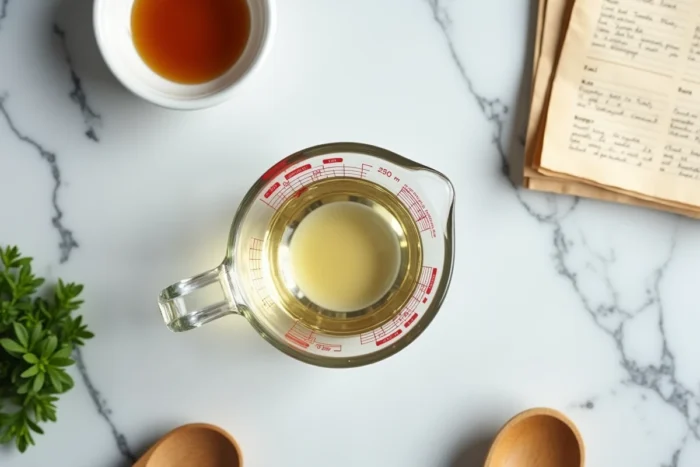
Measuring 25 cl without a measuring cup: tablespoons and common containers
When no graduated container is available, the tablespoon becomes the most accessible backup tool. A level tablespoon holds about 1.5 cl. To reach 25 cl, you need to count around 17 tablespoons. This method requires patience, but it yields a result accurate enough for a sauce, pancake batter, or flan mixture.
Other everyday references complement this approach:
- A teaspoon holds about 0.5 cl. You need 50 to get 25 cl, making it impractical on its own, but useful for adjusting a shortfall of a few centiliters.
- A standard coffee cup corresponds to about 10 cl. Two and a half cups give 25 cl.
- A classic mustard glass (like a Duralex glass) often holds 20 cl. A full glass plus a quarter of that same glass approaches the desired 25 cl.
The main trap comes from the actual size of glasses. The models sold today vary between 15 cl and 25 cl depending on the manufacturer. A glass labeled “standard” in a store no longer guarantees a fixed volume. Before using a glass as a recurring unit of measurement, filling it with water and then pouring the contents into a graduated container allows you to know its exact capacity once and for all.
Conversion 1/4 liter: equivalence table in cl, ml, and dl
A summary table clarifies the transitions from one unit to another and avoids repetitive calculations during preparation.
| Fraction of a liter | Centiliters (cl) | Milliliters (ml) | Deciliters (dl) |
|---|---|---|---|
| 1/8 liter | 12.5 cl | 125 ml | 1.25 dl |
| 1/5 liter | 20 cl | 200 ml | 2 dl |
| 1/4 liter | 25 cl | 250 ml | 2.5 dl |
| 1/3 liter | 33 cl | 330 ml | 3.3 dl |
| 1/2 liter | 50 cl | 500 ml | 5 dl |
The deciliters column is often overlooked, while some recipes from Northern Europe or Scandinavia express volumes in dl. 2.5 dl corresponds exactly to 1/4 liter, which avoids a conversion error if you are following a translated recipe.
French recipes and American cup: the gap to know
Recipes translated from English pose a recurring problem. The American cup does not equal 25 cl. Its actual capacity is around 236 ml, or about 23.6 cl. The difference from a quarter liter represents just over a tablespoon of liquid.
For a single cup, the difference is often negligible. It accumulates when a recipe calls for multiple cups. For three cups of milk, for example, using three times 25 cl instead of three times 23.6 cl adds a surplus that can make a batter too liquid or a cream too runny.
The simplest solution: when a recipe gives volumes in cups, do not round to 25 cl per cup. Measuring 23.5 cl (or removing a tablespoon per cup from 25 cl) gives a result much closer to the original recipe. Rounding a cup to 25 cl introduces a significant cumulative excess from two cups onward.

Precision in cooking: when the approximate quarter liter is sufficient and when it is not
Not all preparations require the same rigor. A soup, a stew, or a marinade can easily tolerate a variation of 1 to 2 cl on a quarter liter. The proportions serve as a guide, and taste does the rest.
Baking works differently. Emulsions, yeast doughs, and egg-based mixtures rely on precise ratios between liquid, fat, and flour. An excess of liquid by a few centiliters is enough to prevent choux pastry from holding or to make a flan too soft.
- For soups, sauces, and vegetable cooking: measuring with a glass or cup is sufficient.
- For cake batters, creams, and ganaches: using a graduated container or a scale is recommended.
- For recipes translated from English: recalculate each cup to 23.6 cl instead of 25 cl.
Mobile apps for culinary conversion are multiplying and now offer calculators that incorporate the density of each ingredient. They usefully complement the measuring cup when the recipe mixes volumes and masses. Keeping a container whose exact volume has been verified once remains the quickest method for daily use, without relying on a screen in the kitchen.