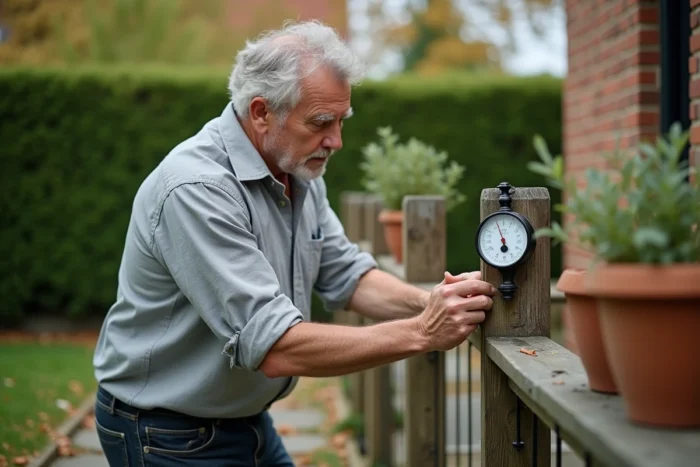
An outdoor thermometer rarely displays the same value as the temperature reported by Météo-France. The discrepancy does not come from the device itself, but from its location. Positioned against a wall in full sunlight or on a concrete terrace, the sensor measures the heat from surrounding surfaces, not that of the ambient air. Understanding this mechanism changes the way a simple household thermometer is installed.
Air temperature and surface temperature: the confusion that skews everything
The official weather reports communicate temperatures measured under very precise conditions, defined by the World Meteorological Organization (WMO). The sensor must be located in a ventilated, white shelter, between 1.5 and 2 m above the ground, above low vegetation and in an open environment. These constraints aim for a single objective: to capture the temperature of the free air, not that radiated by asphalt, a wall, or a roof.
For individuals, these conditions are almost impossible to replicate. Field reports vary on this point: some enthusiasts obtain measurements close to those of official stations with a homemade shelter, while others observe discrepancies of several degrees despite quality equipment. The difference lies less in the thermometer than in what surrounds it within a few meters.
During heatwave episodes, entities like Météo Mayenne or Franceinfo regularly remind us that the values displayed by domestic stations are often higher than the official readings. This phenomenon can be explained by the accumulation of heat from nearby surfaces (walls, slabs, roofs) that radiate towards the sensor. To know where to place an outdoor thermometer according to Loisiragri, one must first identify these sources of stray radiation in their own garden or on their facade.
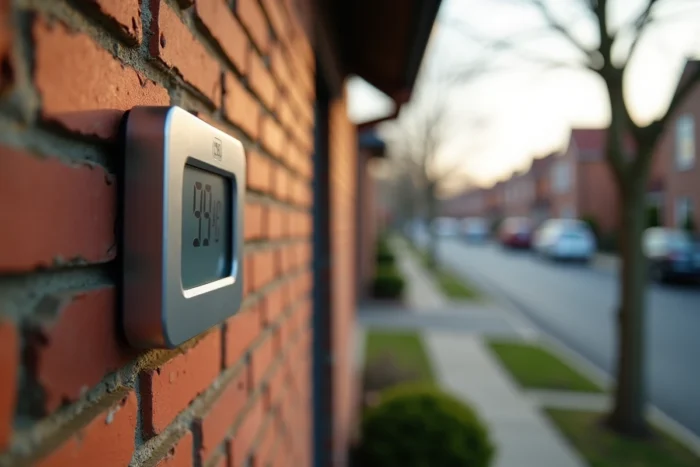
Outdoor thermometer placement: the most common mistakes
The proliferation of connected weather stations for the general public since the mid-2010s has made the problem more visible. These devices are found on balconies, screwed against south-facing walls, or placed on window sills. The result is predictable: the measurement does not reflect the actual outdoor temperature.
Three mistakes consistently occur:
- Mounting the sensor on a wall exposed to direct sunlight. The masonry accumulates heat and releases it for hours, artificially inflating the displayed value, even after sunset.
- Placing the thermometer too close to the ground (below one meter). The air at ground level is warmer during the day and cooler at night than the air at human height, resulting in extreme readings in both directions.
- Installing the sensor under an awning or in a corner of the facade. The air stagnates in these confined spaces, natural ventilation no longer plays its role, and the measured temperature gradually drifts from that of the free air.
These mistakes do not render the thermometer useless, but they transform an air temperature measurement into a measure of the local microclimate. This distinction matters if the goal is to compare readings to weather forecasts or to control a heating system.
Concrete criteria for choosing a reliable location
A correct location is based on a few simple principles, directly inspired by WMO standards adapted to the domestic context.
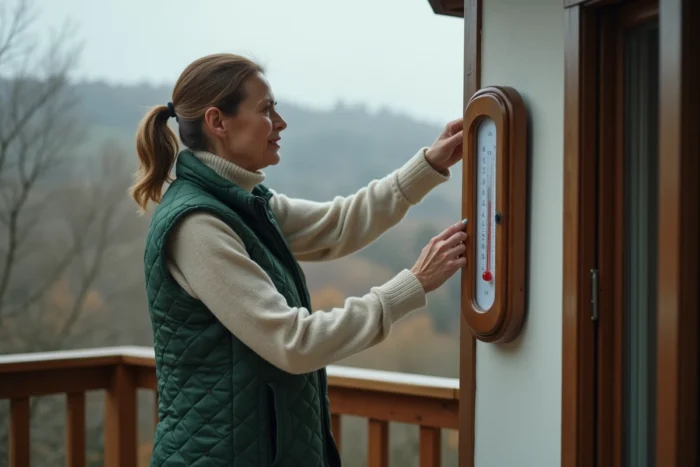
The sensor must be in permanent shade, including during the low sun at the beginning and end of the day. A north-facing wall often meets this condition, provided that the thermometer is not pressed against the wall. A gap of a few centimeters between the sensor and the wall is rarely sufficient: warm air rises along the facade and envelops the sensor.
The recommended height is between 1.5 and 2 meters above the ground, above a natural surface (grass, soil) rather than concrete, light gravel, or metal. If the garden does not allow for this configuration, a support at least two meters away from any masonry or glass surface limits interference.
Natural ventilation is the most underestimated factor. A sensor enclosed in an opaque housing without air circulation quickly overheats. Amateur weather shelters replicate the principle of the official Stevenson shelter: slanted slats that protect from rain and sun while allowing air to circulate freely around the sensor.
Connected weather station: distance and obstacles between sensor and console
For wireless weather stations, the issue of placement is compounded by a technical constraint: the radio range between the outdoor sensor and the indoor console. Manufacturers announce distances in open field, but a load-bearing wall, concrete slab, or metal partition significantly reduces this range.
In practice, each wall crossed can halve the usable distance. A sensor placed at the back of the garden to distance itself from the facades risks losing connection with the console placed in the living room. The compromise is to find a point far enough away from sources of stray heat while remaining within the reliable communication range of the device.
The available data does not allow for a universal distance: it varies according to building materials, the radio frequency used, and the electromagnetic environment. Testing several positions over a few days, checking the continuity of readings on the console, remains the most reliable method before permanently fixing the sensor.
Decorative thermometer or measuring instrument: adjusting expectations
Not all outdoor thermometers claim the same accuracy. A decorative model in enameled metal, mounted on a garden gate post, gives an approximate indication. Its metallic mass absorbs solar radiation, and its position against a rigid support amplifies discrepancies. No repositioning will transform it into a reliable measuring instrument.
In contrast, a digital sensor placed in a ventilated shelter, distant from walls and above a natural ground, can provide readings comparable to official stations within a few tenths of a degree. The investment lies not so much in the sensor as in the installation itself.
The choice between the two depends on the use. To monitor frost in the vegetable garden, an approximation of one or two degrees may suffice. To control heating regulation via an outdoor sensor, every degree of difference translates into a shift in the heating curve and measurable overconsumption. Correctly positioning your outdoor thermometer is not a matter of meteorological purism; it is a matter of the reliability of the decisions made based on its readings.