
Strengthening family bonds doesn’t necessarily require overhauling your schedule. Recent work in family psychology points to a more targeted approach: intensifying micro-moments of connection lasting two to five minutes, integrated into existing routines, rather than trying to multiply long outings or vacations together.
It remains to be seen which formats produce a measurable effect on the quality of exchanges between parents and children, and which are merely generic advice without real impact.
Family micro-rituals versus long activities: what short formats change
| Format | Duration | Recommended frequency | Type of bond strengthened |
|---|---|---|---|
| Intentional micro-ritual (targeted question at mealtime, shared gratitude) | 2 to 5 min | Daily | Parent-child communication, trust |
| Structured family meeting | 15 to 30 min | Weekly | Conflict resolution, cooperation |
| Shared activity (board games, cooking, walking) | 45 min to 2 h | Weekly or bi-weekly | Complicity, shared memories |
| Family outing or trip | Half a day or more | Monthly or occasional | Discovery, intergenerational bond |
The central column of this table reveals a point that most family guides overlook: frequency matters more than duration. A three-minute exchange every evening at bedtime creates a continuous thread of trust between parent and child. A monthly outing, no matter how successful, does not compensate for several weeks of daily silence.
Among the micro-rituals documented by family engagement specialists, three frequently recur: a three to five-minute conversation without phones (in the car, while walking), the weekly sharing of an article or video to spark discussion, and a roundtable where everyone names a positive moment from their day. These formats are accessible on the site partagez.net for families, which lists ideas suitable for every family configuration.
Structured family meeting: a format borrowed from therapy
Several family therapists recommend a short, recurring meeting format, inspired by both therapeutic practices and project management. The principle consists of four distinct phases.
- A round of appreciations where each member names something positive about another family member
- A quick logistical point about the upcoming week (appointments, organization, task distribution)
- A targeted problem-solving session, limited to one or two specific topics to avoid getting bogged down
- Planning a shared enjoyable moment, which concludes the meeting on a note of positive anticipation
The round of appreciations transforms the meeting’s atmosphere. Starting with something positive reduces the defensive posture that parents and children often adopt when a “family discussion” is announced. The problem-solving session, placed in the middle, benefits from this openness.
This format works best when the duration remains short, between fifteen and thirty minutes. Beyond that, younger participants’ concentration drops, and the meeting becomes a burden. Setting a regular time slot, such as Sunday evening, anchors the habit more effectively than a meeting called only in reaction to a conflict.
Adapting the meeting to the children’s age
With children under six, the round of appreciations can take the form of a drawing or gesture. The problem-solving session is limited to a single topic stated simply. With teenagers, rotating the role of meeting facilitator among family members provides autonomy that encourages their involvement.
Active listening in the family: the technique that changes parent-child exchanges
Active listening, rooted in humanistic psychology, involves rephrasing what the other person has just said before responding. In a family context, this technique has a direct effect on trust: the child or teenager who feels understood in their expression, and not just in the factual content, continues to talk.
Rephrasing the emotion before proposing a solution changes the dynamic. A parent who responds, “You seem frustrated by what happened at school,” before giving advice fosters a conversation. A parent who jumps straight to advice encounters a wall.
However, active listening does not mean accepting everything without boundaries. Rephrasing focuses on emotion and experience, not behavior. “I understand that you’re angry” coexists perfectly with “and that rule remains in place.”
Three common mistakes in family communication
Minimizing the expressed emotion (“it’s not a big deal”) cuts off communication faster than any fundamental disagreement. Immediately questioning (“why did you do that?”) puts the child in a defensive position. Comparing with a sibling turns an exchange into competition. These three automatic reflexes destroy the trust built by daily micro-rituals.

Games and shared activities: choosing what creates real exchanges
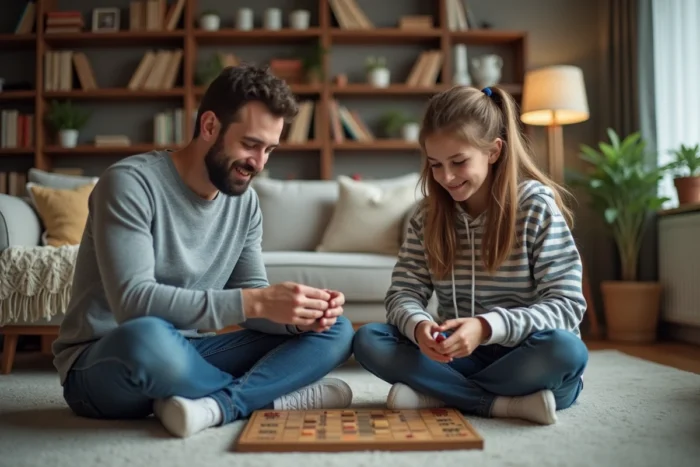
Not all family activities are equal in terms of bonding. Cooperative board games, where the family plays together against the game, generate more communication than competitive games. Cooking together, because it involves coordination and shared results, produces spontaneous exchanges that simply watching a movie side by side does not allow.
The most effective activity is one that all members agree to do regularly. A weekly twenty-minute walk, maintained over several months, strengthens family relationships more solidly than a quarterly creative workshop, no matter how original it is.
The most reliable selection criterion remains the possibility of verbal exchange during the activity. A local multiplayer video game meets this criterion if the family comments, negotiates, and laughs together. An “educational” activity imposed without shared enjoyment misses its target.
Families that combine a daily micro-ritual, a short weekly meeting, and a regular shared activity cover the three dimensions of family bonding: day-to-day trust, collective management of tensions, and complicity through shared pleasure. The regularity of these three formats matters more than their perfection.