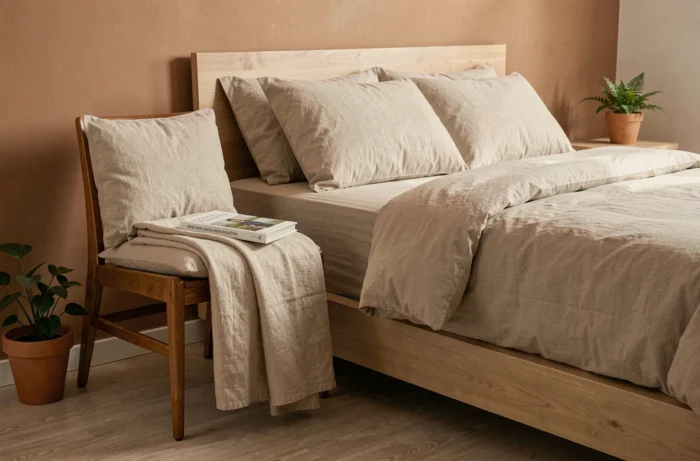
You have probably seen this advice circulating: do not place a chair right next to your bed. Between feng shui, sleep hygiene, and bedroom layout, opinions differ. The answer depends less on a universal rule than on the type of chair, its actual use, and the configuration of your space.
Chair by the bed and mobilization: what hospitals teach
The debate about the chair next to the bed is not limited to interior decoration. In hospital wards, this question is taken very seriously, but not for the reasons one might imagine.
Recent studies conducted within the English NHS show that bedroom furniture, including the chair next to the bed, is now evaluated based on its contribution to maintaining the patient’s abilities. A stable and well-adjusted chair serves as a tool for early mobilization, to help patients get out of bed regularly and prevent physical deconditioning.
The issue is therefore not to ban the chair, but to ensure that it serves a purpose. In this medical context, the chair placed next to the bed helps combat falls and accelerates the return home. For caregivers, the question is about the time spent sitting rather than the presence or absence of the seat.
This observation invites us to think differently at home. When questioning whether to place the same chair next to the bed, the real issue is its concrete usefulness in the room, not a symbolic prohibition.
Feng shui and bedroom: where does this warning come from
The tradition of feng shui attributes an influence to each piece of furniture on the circulation of energy (chi) in a room. According to this approach, the bedroom must remain a space dedicated to rest. Any furniture that reminds one of activity or work disrupts the quality of sleep.
A desk chair placed against the bed, for example, sends a contradictory signal. The brain associates this seat with concentration, ongoing tasks, and pending files. Feng shui translates this idea in terms of energy flow, but the logic also aligns with what sleep specialists call bedroom hygiene: reserving this space for rest.
The problem is not the chair itself
Have you ever noticed that a reading chair installed in a corner of the bedroom does not generate the same feeling as a dining chair wedged between the bed and the wall? Feng shui makes this distinction. It is the association of use that poses a problem, not the object.
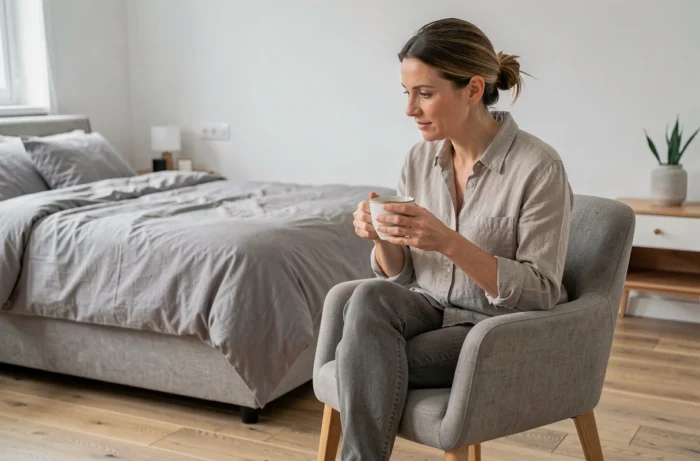
A small low armchair, oriented towards the window and used for reading in the evening, does not create tension. The same chair used at the office all day and then moved next to the bed blurs the room’s references.
Bedroom layout: concrete criteria for decision-making
Rather than a binary prohibition, here are the criteria that allow you to decide based on your own configuration.
- The function of the seat: a chair intended for placing clothes in the evening serves a limited practical role. If it becomes a permanent catch-all, it visually clutters the resting space and harms the feeling of calm in the bedroom.
- The distance from the bed: a seat placed less than an arm’s length from the mattress enters the immediate visual field upon waking and going to bed. Moving it a meter towards a corner of the room often suffices to change the perception of the space.
- Style and proportions: a chair with wide armrests or a high back can visually dominate a small room. A low and discreet model, in light wood or neutral fabric, integrates without creating a tension point in the decor.
- The actual use: if no one ever sits on this chair and it only serves as a support, a valet or a wall hook frees up floor space without sacrificing function.

Chair, armchair, or bench: which seat to choose for the bedroom
The choice of seat depends on what you actually do with it. A reading armchair has its place in a spacious bedroom, provided it is positioned in a dedicated corner, away from the passage between the door and the bed.
A bench at the foot of the bed is a great alternative to a side chair. It does not block circulation, offers a seat for putting on shoes, and can hold a blanket or cushions. This type of furniture comes in wood, metal, or fabric, and adapts to most decor styles.
For small bedrooms, a lightweight stool that can be stored under a desk or bedside table is a good compromise. It remains available when needed without permanently occupying the visual space around the bed.
The trap of the versatile chair
Using the same chair for the dining room, office, and bedroom may seem economical. In practice, this seat shifts from an active context (meals, work) to a resting space. This back-and-forth blurs the function of the bedroom and can hinder falling asleep for those sensitive to their environment.
If you only have one chair, reserve a fixed spot for it in the bedroom, away from the bed, and avoid moving it constantly from one room to another.
The question of the chair next to the bed does not call for a categorical answer. A well-chosen seat, placed at a good distance and used for a clear function, has no reason to be banned from the bedroom. What poses a problem is the furniture that accumulates by default around the bed, without a specific role, and ultimately transforms the resting space into a multipurpose room.