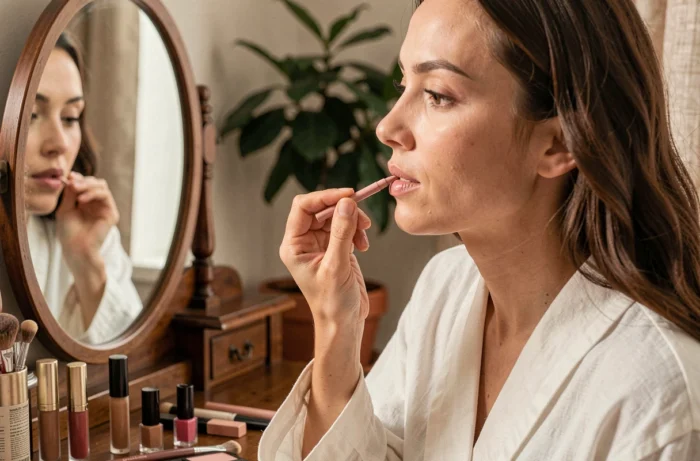
The lip liner serves a specific technical function: to create a waxy barrier around the mouth to prevent the pigments of the lipstick from migrating into fine lines. Its texture, drier and firmer than that of a classic lipstick, adheres to the skin’s contours and forms a physical barrier against color bleeding.
Migration of lipstick: the problem the liner solves
Bleeding, the diffusion of pigment into the small lines around the mouth, depends on several factors. The formula of the lipstick plays a crucial role: creamy or glossy textures, rich in oils, glide more than matte formulas. The condition of the skin also matters, as very hydrated lips with a thick balm applied just before can promote color movement.
The liner intervenes at this precise stage. Applied on the natural contour, it sets a boundary that the lipstick does not cross. Its effectiveness depends on the method: a layer that is too thick of lipstick on top, or a still greasy surface under the liner, can negate the barrier effect. The idea of using a liner with lipstick is based on this logic of preparing the contour before applying color.
A long-lasting matte lipstick, formulated with film-forming polymers, migrates much less than a creamy lipstick. In this case, the liner becomes optional for longevity. Its utility then shifts to another function: correcting the shape of the lips.
Lip liner and contour correction: application technique
The liner’s outline is not limited to following the natural edge of the lips. Slightly going above the Cupid’s bow or on the outer corners creates an illusion of volume. Staying below the natural contour visually reduces the size of the mouth. These adjustments require a well-sharpened tip and a slow hand.
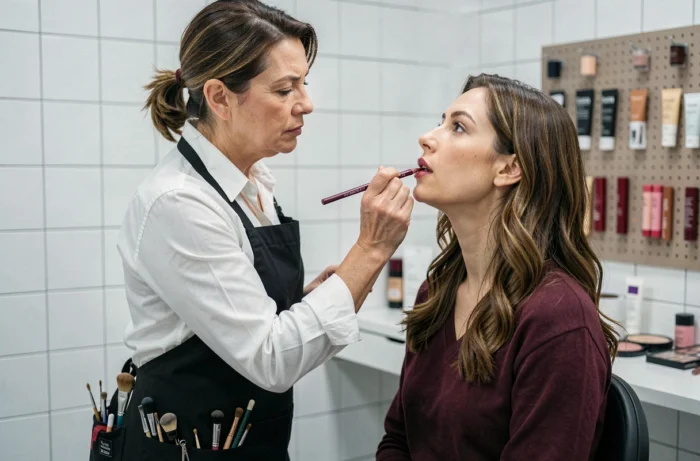
The method that yields the best results follows a specific order:
- Prepare the lips with a gentle scrub, then apply a thin balm and let it absorb for a few minutes before dabbing off the excess with a tissue.
- Outline starting from the center of the upper lip (the Cupid’s bow) towards the corners, then do the same on the lower lip.
- Partially or fully fill the surface of the lips with the liner to create an even base that extends the wear of the lipstick.
- Apply the lipstick in a thin layer on top, using a brush or directly from the bullet depending on the texture.
Filling the entire surface of the lips with the liner changes the game for dark shades. The colored base prevents transparent areas that appear when the lipstick fades throughout the day, and the result remains uniform longer.
Choosing the shade of the liner: exact match or softened contrast
The classic advice is to choose a liner in the same shade as the lipstick. This approach works for a natural and discreet look. A liner that is slightly darker adds depth to the contour and enhances the definition of the mouth.
The current trend moves away from the sharply defined contour that dominated the 1990s. The liner is more blended into the lips, then paired with a balm or gloss rather than an opaque lipstick. The softened contour replaces the sharp line, giving a more worn, less graphic effect.
Circana data shared by Woman’s World also confirms that lip liners are experiencing a strong commercial resurgence, driven by these modernized contouring routines and social media.
For a natural everyday result, a universal rosy nude liner covers most needs. It pairs well with both classic lipstick and tinted balm, without creating a visible gap if the lipstick fades during the day.
When lip liner is not necessary
The liner does not have a place in every makeup routine. With a clear gloss or a light tinted balm, drawing a visible outline creates an artificial contrast. The fluid texture of the gloss will overflow beyond the drawn line anyway, making the liner unnecessary.
Long-lasting matte liquid lipsticks present another case. Their formula dries upon contact and hardly moves. The liner underneath can even create a buildup that accentuates the lines of the lips instead of smoothing them.
The liner becomes counterproductive on very dry or irritated lips. Symptoms of contact cheilitis (tingling, redness, flaking) can be exacerbated by the friction of a firm tip on compromised mucosa. In case of a persistent reaction to a lip product, it is better to simplify the routine rather than pile on layers.
Lip liner and makeup longevity: what makes the difference
The overall wear of lip makeup depends on the entire routine, not just the liner alone. A liner applied on properly exfoliated and lightly hydrated lips holds better than a liner placed on a greasy surface. Similarly, applying the lipstick in thin successive layers rather than in one thick layer improves pigment adherence.
Intermediate blotting (dabbing with a tissue between layers) remains the most effective technique for extending the lifespan of makeup. The liner contributes to this result, but it is just one link in the chain.
The choice to wear a liner with lipstick thus depends on three concrete variables: the formula of the lipstick (creamy or long-lasting matte), the desired visual result (sharp contour, softened effect, or natural finish), and the condition of the lips’ skin. A well-chosen and correctly applied liner extends wear and refines the shape, but a matte lipstick applied on prepared lips holds very well without it.