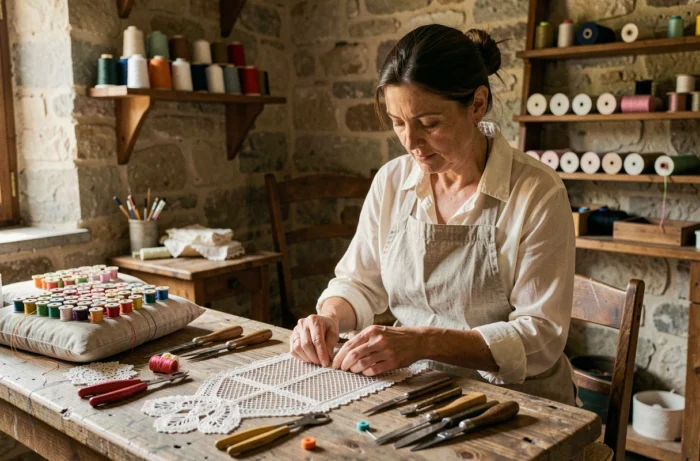
When Sophie Hallette, a historic lace maker based in Caudry, publishes a recruitment offer to train new operators on Leavers looms, the question is no longer whether artisanal lace still attracts. It does. The problem lies upstream: finding candidates willing to learn skills that require several years of practice, on machines whose operation is not taught in any general school.
This tension between the need for skilled labor and the scarcity of training structures shapes the recent news of the French lace sector much more than fashion shows or Pinterest trends.
Recruitment and transmission in Leavers lace workshops
The labor shortage in mechanical and artisanal lace workshops is far from an abstract issue. In Caudry as in Calais, companies still operating Leavers looms struggle to fill technical positions. Training a lace maker or a finisher takes several years, and retirements are not compensated at the same pace.
You can follow the announcements and initiatives of the sector by visiting the Madame Dentelle website, which regularly shares news from the workshops and events related to artisanal lace.
The risk when discussing transmission is reducing the technical gesture to a marketing argument. A company that highlights “handmade” or “ancestral know-how” without concretely investing in training new operators uses heritage as a veneer. The difference between real transmission and marketing can be measured quite simply: does the workshop recruit, train, and retain its apprentices over time?
In Toulouse, designer Céline Ménard incorporates Calais lace, tulles, and embroideries into her bridal collection. She presents transmission as a method of creation, not as a slogan. Her showroom-workshop functions as a place where textile know-how is practiced daily, not just during open house days.
European geographical indication for Calais-Caudry lace
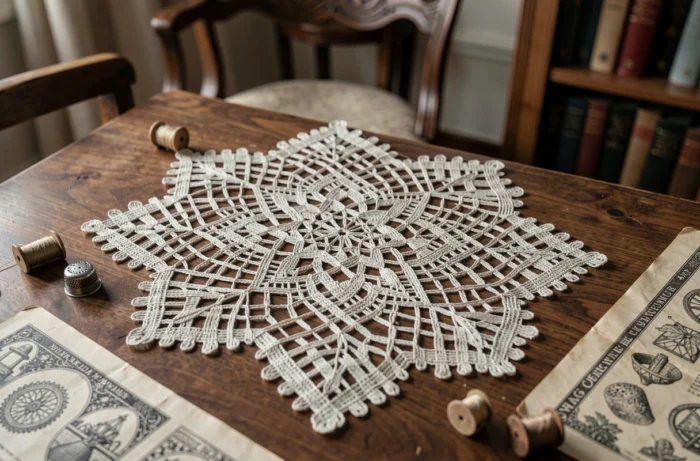
The European Union has recently expanded its framework for protecting geographical indications to include artisanal and industrial products. For Calais-Caudry lace, this change goes far beyond symbolism. The specifications reserve the designation for lace produced on Leavers looms within the defined geographical area around Calais and Caudry.
In practical terms, this European protection provides a legal tool that the French geographical indication alone did not cover with the same scope. It allows for combating abusive uses of the designation in the European market, where lace produced industrially outside the area could previously claim a vague origin.
What the European GI changes for manufacturers
For the workshops concerned, the consequences are operational:
- The obligation to produce on Leavers looms within the defined area protects local manufacturers from competition from low-quality mechanical lace labeled “Calais”
- The specifications impose verifiable manufacturing criteria, which structures the sector around common standards
- Access to European legal protection facilitates recourse in cases of counterfeiting or name infringement in export markets
Feedback varies on the immediate commercial impact of this GI, but the legal tool now exists at the level of the European internal market.
Artisanal bobbin lace: gatherings that train the next generation
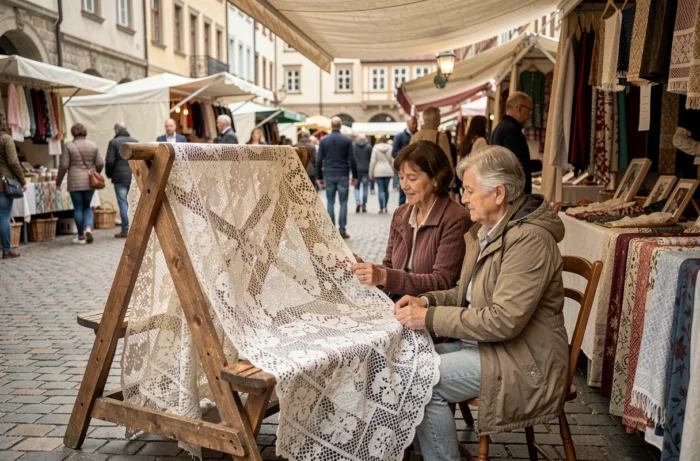
On the bobbin lace side, transmission occurs through another channel: the couviges and international gatherings of lace makers. These meetings, far from being mere folkloric events, function as intensive workshops where practitioners of all levels exchange regional techniques.
In Puy-en-Velay, the large couvige attracts lace makers from afar, sometimes from abroad. The interest of these events lies in their practical dimension: specific stitches are learned, gestures are corrected, and methods are confronted. The couvige partially replaces workshop learning for a practice that no longer has institutional training structures.
Transmitting without museum-ifying
The challenge for these gatherings is not to become heritage showcases disconnected from creation. When a lace maker adapts a traditional pattern to a contemporary project (accessory, upholstery fabric, artistic piece), she keeps the technique alive.
It is also observed that the youngest participants often arrive through indirect paths: embroidery, weaving, sewing. They are not looking to reproduce a fixed heritage but to integrate bobbin lace into a broader textile practice. This is probably the most realistic way to ensure the continuity of the gesture.
Upcycling old lace: a niche market that is structuring
In Paris, the workshop Les Fleurs Studio works exclusively with old scraps and recovered pieces, some dating back several centuries. This approach, halfway between creation and conservation, meets a growing demand for unique pieces with a strong textile load.
Upcycling old lace transforms dormant stock into luxury raw material. The creators dedicated to this must master both textile restoration and clothing design, which naturally reduces the number of practitioners capable of carrying out these projects.
Pierre Groppo, fashion and lifestyle editor of Vanity Fair France, summarizes the phenomenon: lace immediately conveys the idea of craftsmanship and preciousness that adds value to clothing, in a context where fashion houses seek to stand out by quality rather than volume.
- Recovered old lace offers patterns and textures that current production does not replicate identically
- Each upcycled piece is unique by definition, which corresponds to the expectations of a clientele tired of mass production
- The fragility of the material imposes specific assembly techniques, which themselves constitute a rare know-how
French artisanal lace is going through a period where legal protection tools, recruitment initiatives, and transmission practices through gatherings converge. The common thread remains the same: to maintain concrete technical gestures, whether it is operating a Leavers loom in Caudry or manipulating bobbins in Puy-en-Velay. It is on this ground, not on fashion trends, that the survival of the sector is at stake.