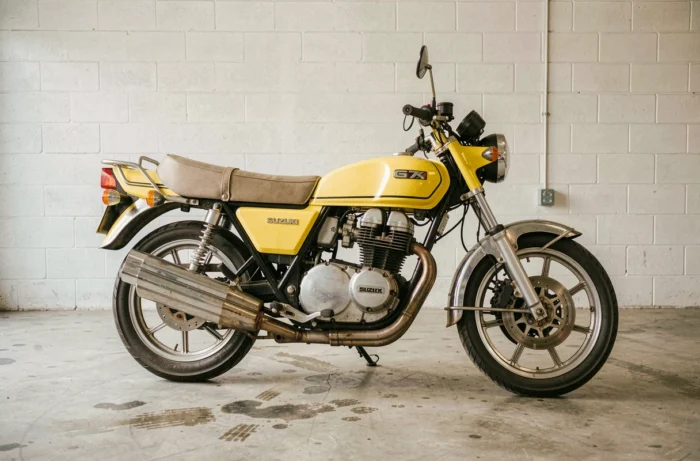
The Suzuki GT 750, produced between 1972 and 1977, is a liquid-cooled two-stroke three-cylinder motorcycle. This architecture, rare for the time on a Japanese production bike, earned it the nickname “bouillotte” in France and “Water Buffalo” across the Atlantic. In the collector’s market, the value of a GT 750 directly depends on the model year, the original color, and the consistency between these two elements.
Model Letters and Mechanical Evolution of the Suzuki GT 750
Suzuki designated each model year with a suffix letter. The series begins with the model J (1972), followed by the K (1973-1974), L (1974), M (1975), A (1976), and B (1976-1977). This nomenclature is not just an administrative detail: it affects the availability of parts, technical specifications, and, above all, the associated color combinations.
The early models (J and K) are distinguished by a dashboard with separate gauges and a tank with more angular shapes. The later versions (A and B) adopt a smoother fairing, double front disc brakes, and different finishes. These evolutions mean that the later versions are treated differently by specialists than the early models, both aesthetically and in terms of market value.
To delve deeper into the precise correspondences between model letters, paint codes, and destination markets, the Suzuki 750 GT guide on Speeder details each combination year by year.
Suzuki GT 750 Paint Codes by Model Year and Destination Market
Simply saying a GT 750 is “blue” is not enough. Each model year had specific manufacturer paint codes, and the shades offered varied depending on whether the motorcycle was intended for Japan, Europe, or North America.
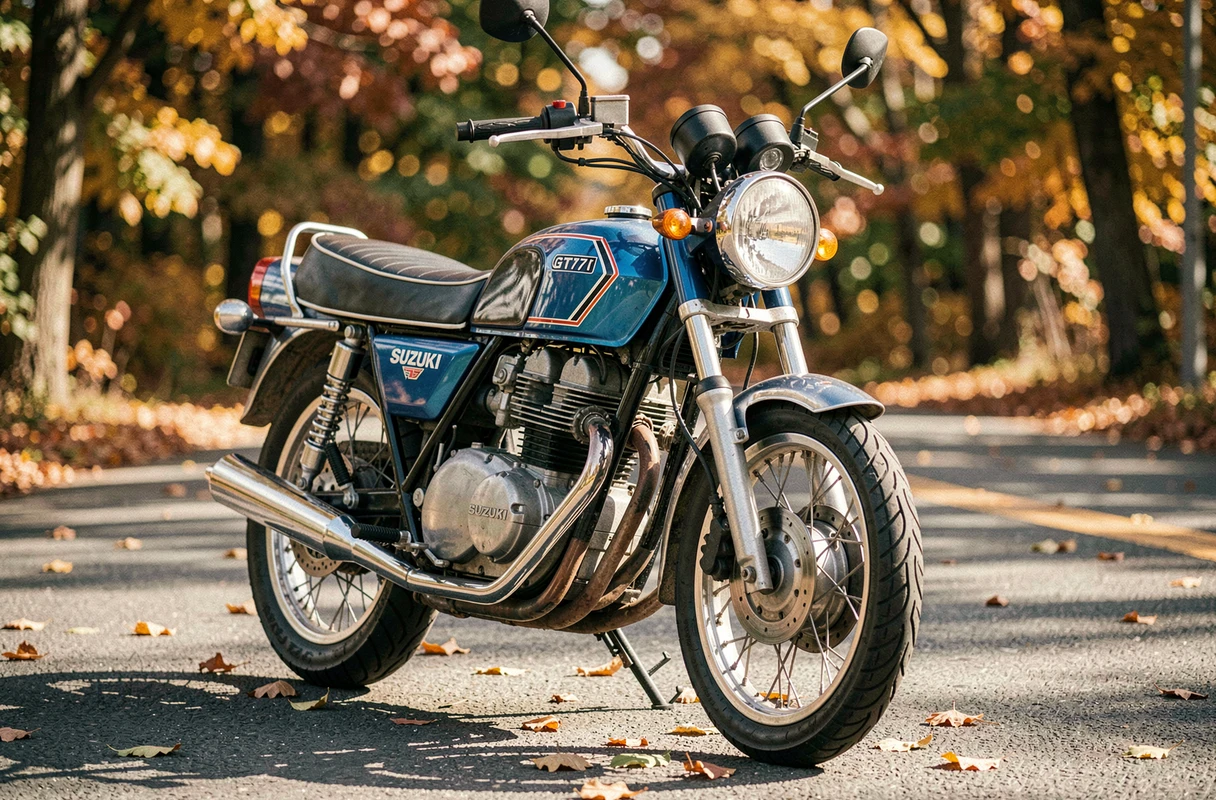
The 1972 model J illustrates this complexity well. Outside of Japan, three main colors were offered: Newport Blue (code 195, also known as Candy Jackal Blue), California Burgundy (code 216, or Candy Lavender), and a gold called Candy Yellow Ochre (code 253). This gold was not available in the United States but was in Canada and Switzerland. The frame remained black (code 019) across all markets.
The painted elements in the main shade included the tank, radiator cover, headlight, fork ears, and side covers. The accent color, used on the pinstripes and decorative bands, also varied according to the main color code.
- The “candy” shades (transparent over a metallic base) are the most difficult to reproduce during a restoration, as they require a multi-layer painting process true to the original methods.
- The metallic blue, present on several model years under different codes, is the color most spontaneously associated with the GT 750, but each year has its own shade.
- The brown and burgundy shades of the early models are now among the most sought after by collectors, as they visually mark the belonging to the J and K series.
Identifying the Authenticity of a GT 750: Frame, Paint, and Serial Number
A rough visual match between color and model guarantees nothing. Reliable identification relies on the intersection of three elements: the frame number, the paint code, and the model year. The frame number allows tracing back to the production series and the original market. The paint code, when still legible on the manufacturer’s plate or in accompanying documentation, confirms or denies the current shade.
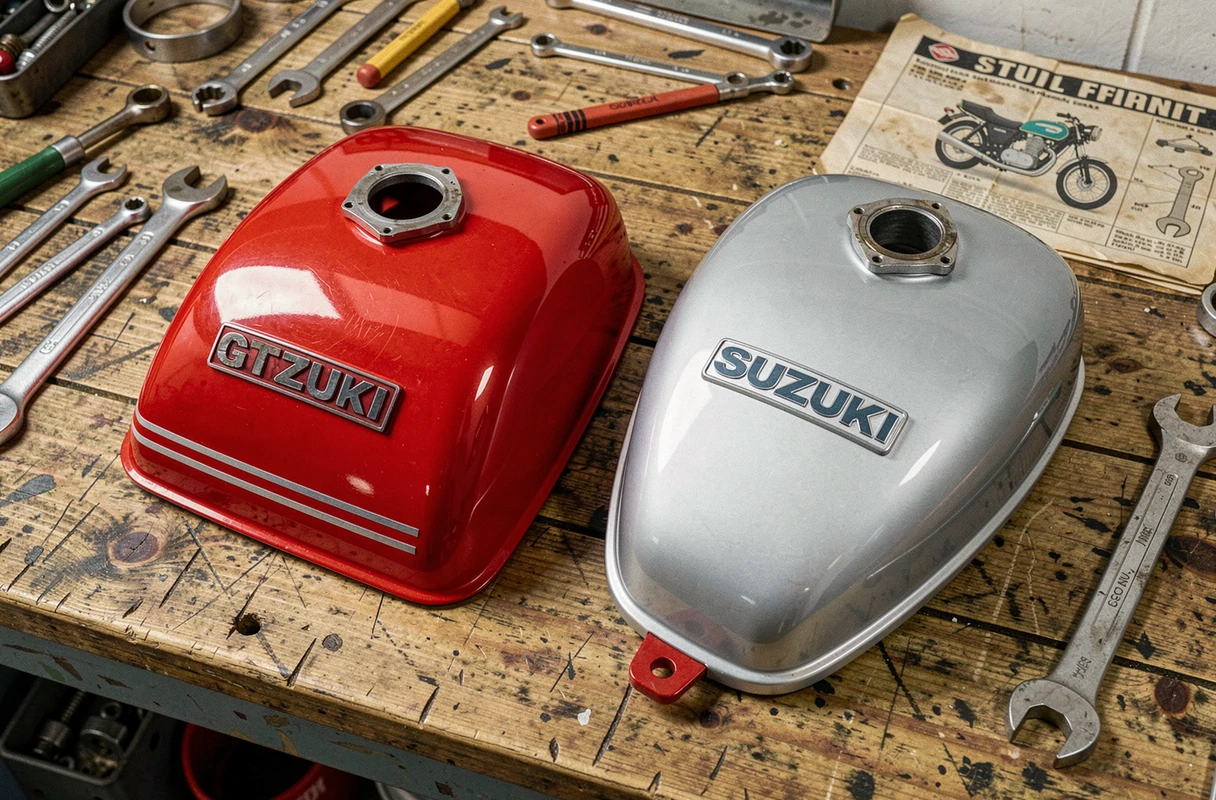
This verification is crucial in the second-hand market. Recent listings show that sellers increasingly emphasize color/model year consistency as a value argument. A GT 750 repainted in a correct shade for its year will sell better than a motorcycle whose color does not match any period code, even if the paint quality is impeccable.
The main problem for buyers: reference documentation remains very fragmented. There is no single source recognized by all collectors. Information circulates between a detailed English-language field guide, specialized French-speaking forums (notably one dedicated to Suzuki GT triples and two-stroke twins), period Japanese catalogs, and partial databases. Cross-referencing multiple sources before validating the authenticity of a specimen remains the most reliable method.
Suzuki GT 750 in Collecting: Model Years that Concentrate Demand
The early model years (J and K) attract purists looking for the original aesthetic with its separate gauges and characteristic candy shades. The model J, as the first year of production, holds a special status in the hierarchy of collectors.
The later versions A and B appeal to a different profile of buyers, drawn by more modern braking and a more refined finish. The choice of model year depends on what the owner values: raw historical authenticity or everyday usability.
- A documented original color J or K model, with paint in good condition, represents the top of the market.
- A properly restored A or B model in period shades remains more accessible while offering a more comfortable use.
- Examples whose color does not match the model year, or that carry a shade never offered by Suzuki, see their value decrease significantly.
The global production of the GT 750 has remained modest, which maintains a certain rarity in the French market. Complete examples, with original documentation and consistent paint, are becoming increasingly rare as time passes and approximate restorations multiply.
For a buyer or restorer, the first step remains the same: identify the model letter from the frame number, find the corresponding paint codes for the destination market, and then compare with the actual condition of the motorcycle. This method, applied systematically, avoids costly mistakes and protects the heritage value of each specimen.