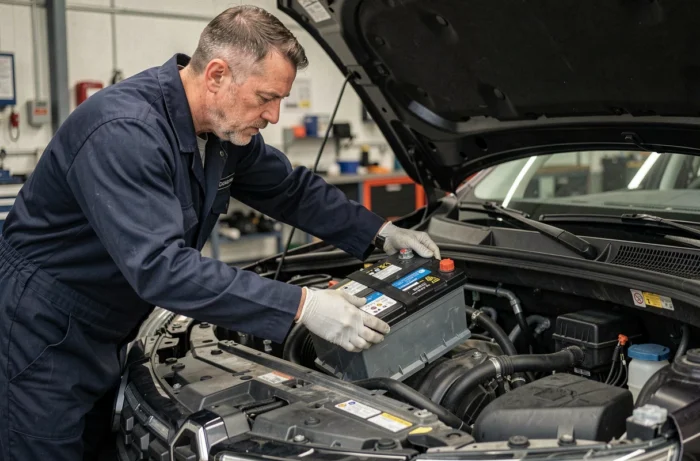
Replacing the battery of a Dacia Jogger is not just about disconnecting two terminals and sliding in a new accumulator. Depending on the engine type and whether or not the Start & Stop system is present, the type of battery, the removal procedure, and especially the post-installation steps vary significantly. This article measures these differences to avoid charging defects or electronic anomalies after intervention.
EFB, AGM, or conventional lead-acid battery: compatibility based on Dacia Jogger engine type
The first reflex before buying a replacement battery is to identify the original technology. On the Jogger, the distinction is based on the presence of the Start & Stop system.
| Criterion | Conventional lead-acid battery | EFB battery | AGM battery |
|---|---|---|---|
| Technology | Free liquid electrolyte | Enhanced Flooded Battery, reinforced plates | Absorbed Glass Mat, immobilized electrolyte |
| Compatible with Start & Stop | No | Yes (moderate cycles) | Yes (intensive cycles, energy recovery) |
| Nominal voltage | 12 volts | 12 volts | 12 volts |
| Relative lifespan | Standard | Higher than lead-acid | The highest of the three |
| Relative price | The lowest | Intermediate | The highest |
A vehicle equipped with Start & Stop requires at least a compatible EFB or AGM battery. Installing a conventional lead-acid battery on a Start & Stop Jogger degrades the system’s operation and can cause erratic restarts or even a permanent disabling of the function.
Conversely, installing an AGM on a version without Start & Stop works without issue, but represents an unnecessary extra cost. The rational choice is therefore based on the vehicle’s technical specifications, not on the lowest price on the shelf.
Before changing the Dacia Jogger battery, check the label attached to the original battery: it indicates the capacity in ampere-hours, the cold cranking current, and the technology (EFB or AGM mentioned on the casing).
Electronic battery registration: a step that the Jogger may require
On vehicles equipped with a battery management system (BMS), the computer adjusts the charging strategy based on the measured state of the accumulator. As the battery ages, the BMS gradually increases the charging voltage to compensate for capacity loss.
The problem arises during replacement: if the new battery is not registered with the computer, it continues to apply the charging strategy of the old battery. As a result, the new battery receives inappropriate voltage, which reduces its lifespan or generates fault codes.
When battery coding is necessary on the Jogger
Hybrid engines and some recent gasoline versions incorporate an active BMS. In this case, a diagnostic tool connected to the OBD port is necessary to reset the wear counter and register the parameters of the new battery (capacity, technology, date of commissioning).
- Check the maintenance booklet to see if your Jogger mentions “battery registration” among the maintenance operations
- A generic OBD-II diagnostic tool is rarely sufficient: often a device compatible with the Renault/Dacia protocol is required (the Jogger shares its CMF-B platform with several Renault models)
- Without this registration, the engine management light may illuminate a few days after replacement, and the Start & Stop may refuse to operate
Electronic registration distinguishes a successful replacement from an intervention that creates new problems. If you do not have access to a diagnostic tool, a quick visit to a Dacia representative or an equipped mechanic remains the most reliable solution.
Removing and reinstalling the 12-volt battery on Dacia Jogger: practical precautions
The Dacia owner’s manual emphasizes several safety points that must be strictly followed when handling the battery.
- Turn off all energy consumers (dome lights, radio, ventilation) before disconnecting the battery
- Wait at least one minute after the engine stops before any intervention on the terminals
- Disconnect the negative terminal first, then the positive terminal, to avoid any accidental short circuit
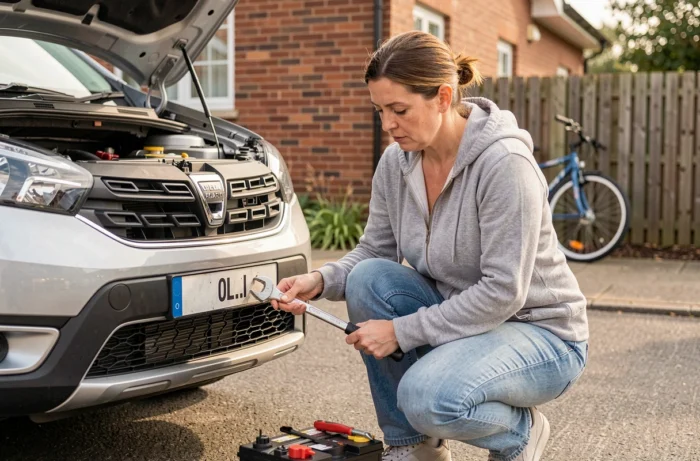
- Do not place any metallic object on the battery: a wrench placed between the two terminals creates an instant electric arc
- During reassembly, reconnect the positive terminal first, then the negative
On the Jogger, the 12-volt battery is located in the engine compartment. Access is relatively clear compared to other models in the group, but the plastic engine cover must be removed beforehand.
Resetting equipment after reconnection
A power cut, even brief, resets several parameters: clock, radio station memories, position of electric windows. On the Jogger, the impulse windows require a relearning procedure (full ascent held for a few seconds) to restore their automatic operation.
The radio code may also be requested upon restart. Keep it in the glove compartment or note it down before the intervention.
Recycling the used battery: obligations and REP system
The French extended producer responsibility (REP) system for batteries has been significantly overhauled. Automotive batteries can no longer be treated as ordinary household waste. Separate collection and deposit in a dedicated system are explicitly required.
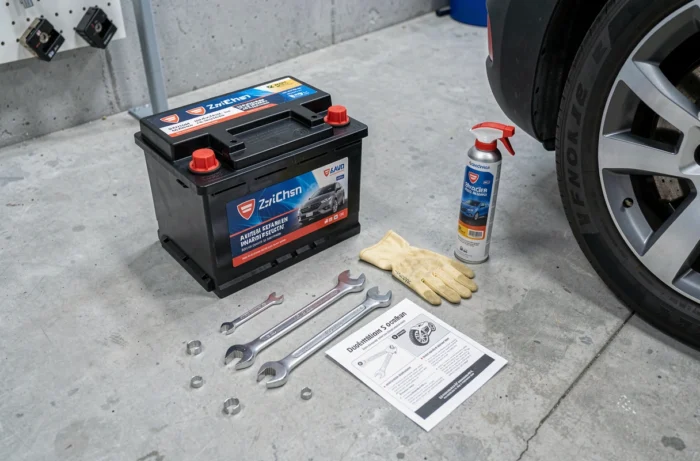
In practice, you have two options: return the old battery to the point of sale when purchasing the new one (most retailers apply a deposit refunded upon return) or drop it off at an approved end-of-life vehicle (VHU) center. Municipal waste disposal sites also accept lead batteries in most cases.
Improperly recycling a lead battery exposes you to environmental risks related to sulfuric acid and lead, both classified as hazardous substances. The gesture is simple and free at almost all collection points.
Ultimately, replacing a battery on the Dacia Jogger hinges on a point that many tutorials overlook: technological compatibility and electronic registration are just as important as the mechanical act itself. Identifying the correct technology (EFB, AGM, or conventional), checking if the computer requires coding, and respecting the order of terminal disconnection are the three parameters that separate a clean intervention from repeated breakdowns.