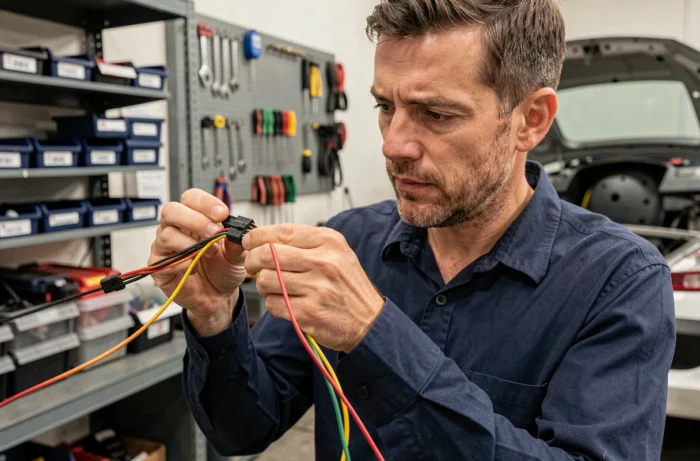
Replacing the original radio in a Peugeot 206 or 207 requires understanding an electrical harness that differs significantly from one model year to another. The ISO connector, the presence or absence of the CAN bus, and the type of factory-installed unit (VDO, Clarion, Siemens) determine the actual wiring behind the front panel. This guide details the specific wire color correspondences for these two models and the points of caution that generic diagrams overlook.
CAN Bus and ACC Signal: What Changes Between the 206 and 207
On the Peugeot 206, the wiring remains conventional. The accessory power (ACC) wire physically arrives at the connector, allowing for a direct connection to a universal radio without additional interface. The logic is linear: connect the yellow wire to permanent power, the red to ACC, and the black to ground.
The 207 complicates matters. Versions equipped with an RD4 unit or a multifunction display communicate via the vehicle’s CAN network. The physical ACC wire disappears in these configurations: it is the intelligent service box (BSI) that manages the power-up of the radio via a digital message. Connecting an aftermarket unit without taking this into account results in either a radio that stays on continuously (draining the battery) or a unit that does not turn on at all.
To work around this issue on a CAN-equipped 207, a CAN-bus to ACC signal adapter must be used. This box converts the digital information into an analog signal usable by the red wire of the new unit. A complete guide on the wiring diagram for Peugeot 206 and 207 radios details the references for harnesses suitable for each model year.
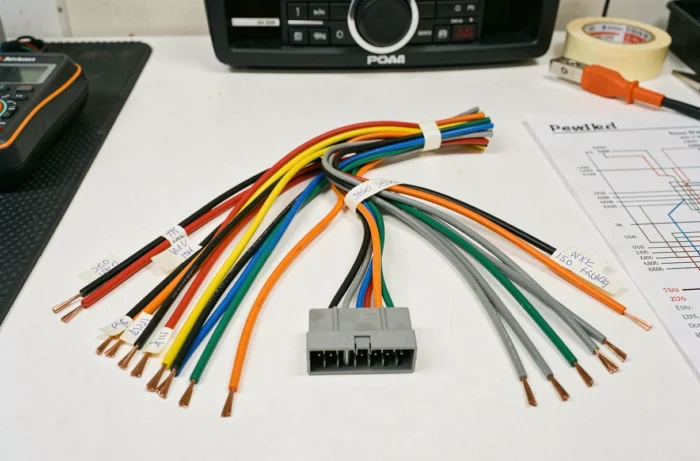
Power and Ground Wire Colors on Peugeot 206 and 207
The power ISO connector (block A, often black) groups the power wires. On these two Peugeot models, the correspondences generally follow the ISO standard in most cases, with some particularities related to the original equipment manufacturer.
- Yellow wire: +12V permanent, directly connected to the battery. It retains the memory of the unit (stored stations, settings). On both the 206 and 207, this wire is almost always present in the connector.
- Red wire: +12V after ignition (ACC). Physically present on the 206 and on 207s without CAN bus. Absent on 207s with RD4 unit, where it must be recreated via an adapter.
- Black wire: chassis ground. Connected to a ground point in the vehicle. A poor connection on this wire generates audible noise in the speakers.
- Blue wire: antenna control or output for external amplifier. On the 207, this wire can also control the antenna integrated into the rear window, giving it a dual function that should not be overlooked.
- Orange wire: dashboard lighting signal, used for the brightness adjustment of the unit’s screen. Often ignored, it enhances nighttime driving comfort.
Speaker Wires for Peugeot 206 and 207: Pair Identification
The audio ISO connector (block B, often brown) carries the signals to the speakers. Each speaker uses a pair of wires: one positive and one negative, identified by a solid color and a striped color.
On the 206, the speaker wiring generally follows this scheme:
- Front left: gray (positive) and gray/black (negative)
- Front right: white (positive) and white/black (negative)
- Rear left: green (positive) and green/black (negative)
- Rear right: purple (positive) and purple/black (negative)
On the 207, these correspondences remain similar, but field reports diverge on the facelifted versions. Some factory installations reverse polarities or use slightly different shades depending on the manufacturer. Checking each pair with a multimeter before soldering or crimping remains the most reliable precaution.
Reversing the polarity of a speaker does not destroy it but causes acoustic phase cancellation: the bass partially cancels out, and the sound seems hollow. If the output after installation appears weak, this is the first point to check.
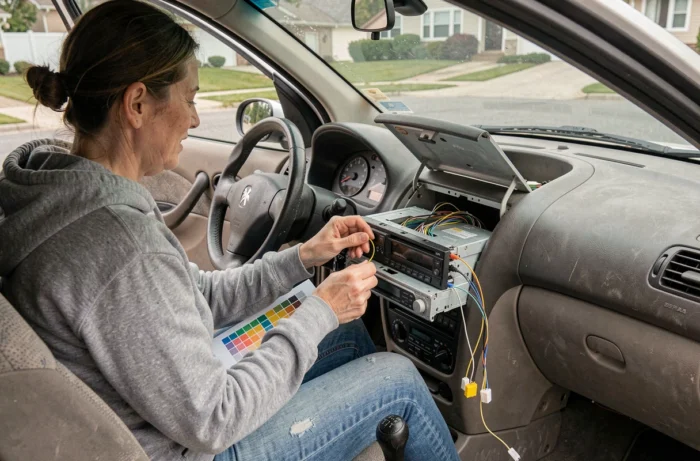
Android Auto Radio on Peugeot 206 and 207: Constraints of the Original Harness
In recent years, the installation of multimedia units compatible with Android Auto or CarPlay in older vehicles has become widespread. On a 206 in 1-DIN format, the replacement is direct as long as an adapter frame is used to fill the space. On the 207, the 2-DIN format is often possible thanks to the wider original location, but the CAN bus and steering wheel controls become determining factors.
Maintaining steering wheel controls after changing the unit requires a dedicated interface. Several manufacturers (Pioneer is frequently cited as a reference in this area) offer modules that translate the signals from the steering wheel buttons into commands compatible with the new radio. Without this interface, the volume and source change buttons on the steering wheel become inoperative.
Checks to Make Before Installation
Before unplugging the original unit, note the radio code written on the card or in the service booklet. On some 207s, removing the unit triggers a BSI lock that requires a reset by a professional if the code is not available.
Testing each wire with a multimeter in direct current mode allows you to confirm the color/function correspondence. A yellow wire that does not deliver voltage with the engine off indicates a fuse problem or wiring that does not conform to the standard diagram. It’s better to spend ten minutes measuring than risk a short circuit on the vehicle’s harness.
The wiring of a 206 remains accessible to a methodical DIYer. That of a 207 with a CAN bus requires a minimum of additional equipment and careful reading of the documentation specific to the exact model year of the vehicle.