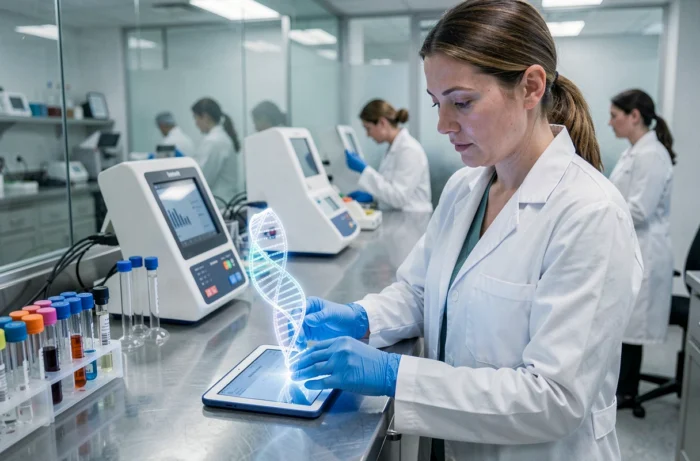
A patient receives treatment tailored to their genetic profile. An algorithm detects an anomaly on an X-ray even before the radiologist examines it. These situations already exist in several European hospitals. Health innovations are no longer science fiction; they are concretely transforming diagnosis, care, and patient follow-up.
AI Act and medical devices: the regulatory timeline that conditions everything
Competing articles list promising technologies. They often overlook a crucial parameter: the European legal framework sets the actual pace of deployment. An innovation can be technically ready but remain stalled due to regulatory non-compliance.
The European AI Act structures this timeline into several phases. Bans on the use of artificial intelligence deemed to pose “unacceptable risk” have been effective since February 2, 2025. Certain digital health applications, particularly those involving some form of behavioral manipulation or intrusive biometric monitoring, are directly affected.
Since August 2, 2025, obligations concerning general-purpose AI models apply. Specifically, any clinical chatbot or medical decision support co-pilot based on a language model must meet documentation, governance, and risk management requirements. Resources available at https://www.lasantedemain.com/ allow tracking these regulatory developments and their impact on care pathways.
The next phase, scheduled for August 2026, will require full compliance for AI systems classified as “high risk” in the medical sector. Diagnostic, triage, or therapeutic recommendation support devices will need to demonstrate compliance with the Medical Device Regulation (MDR) and the AI Act simultaneously. This dual compliance with MDR and AI Act represents an unprecedented challenge for manufacturers.
Artificial intelligence in medical diagnosis: beyond the hype
Have you seen headlines claiming that AI surpasses doctors in radiology? The reality on the ground is more nuanced and more interesting.
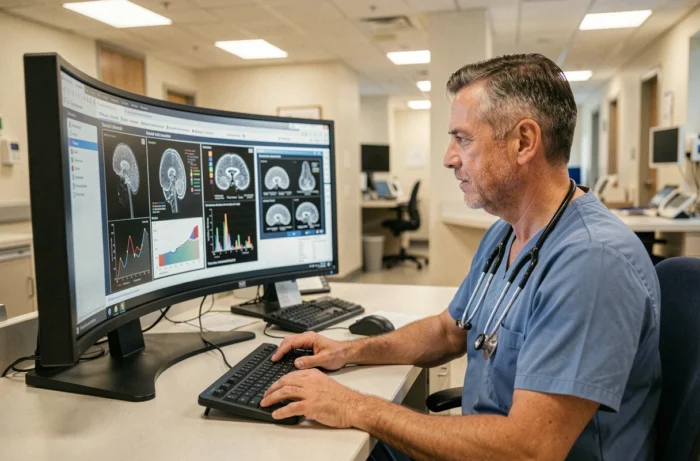
Artificial intelligence applied to diagnosis functions as a prioritization filter. The algorithm analyzes an image (CT scan, MRI, X-ray) and flags suspicious cases for the practitioner. The doctor retains the final decision-making authority. This “co-pilot” function reduces the reading time for exams and decreases the risk of missing an anomaly in large series of images.
In radiology, solutions like the one developed by Milvue already offer complete triage of osteoarticular and pulmonary pathologies. The tool does not replace the radiologist. It highlights priority images in a queue that can contain hundreds of exams.
The most concrete added value lies in situations of medical shortage. In hospitals where a single radiologist covers night emergencies, a pre-triage algorithm changes the game in terms of patient safety.
Limitations to be aware of
An algorithm trained on data from a homogeneous population can produce biased results on other groups. The quality and diversity of training data directly condition the reliability of AI-assisted diagnosis. This is a point that the transparency obligations of the AI Act (Article 50) aim to regulate, with mandatory labeling of content generated by artificial intelligence.
Personalized medicine and biomarkers: tailoring treatment to the patient
For a long time, medicine operated on a statistical model: an effective drug for the majority of patients was prescribed to everyone. Precision medicine reverses this logic.
Biomarkers allow for identifying which treatment will work for which biological profile. In oncology, liquid biopsy (a simple blood draw) detects circulating tumor DNA fragments. It allows for tracking cancer progression without repeated surgical interventions and adjusting treatment based on the patient’s actual biological response.
Targeted therapies illustrate this shift in approach:
- They act on molecular mechanisms identified through genomic analysis, not on all cells like traditional chemotherapy
- Treatment is selected based on the patient’s tumor profile, reducing unnecessary side effects
- FLASH radiotherapy, which delivers the dose in a fraction of a second, limits damage to surrounding healthy tissues
This personalization of care relies on a considerable volume of medical data. Genomics produces massive files for each patient. Storing, securing, and utilizing this data is the real bottleneck of personalized medicine, far more than the technology itself.

Digital twins and 3D bioprinting: simulating before treating
A digital twin is a virtual replica of an organ or the entire body of a patient. It allows simulating the effect of a treatment or surgical intervention before it is performed. The surgeon tests different scenarios on the digital model, identifies risks, and optimizes their actions.
3D bioprinting takes a complementary path. Instead of simulating, it manufactures. Tissue structures (cartilage, skin, bone fragments) are already produced in the lab from the patient’s cells. The ultimate goal is to produce compatible grafts without relying on a donor.
These two technologies share a common point: they remain largely at the experimental stage for complex applications (complete organs, real-time hemodynamic simulations). Their integration into standard care pathways will take several years, especially since the dual regulatory compliance of MDR and AI Act will also apply to simulation software classified as medical devices.
Connected devices and remote monitoring
Connected medical devices (watches, glucose sensors, communicating blood pressure monitors) complete this landscape. They enable continuous monitoring of patients outside the hospital and transmit data to healthcare professionals in real time.
Their main interest lies in the early detection of decompensations. A heart patient equipped with a connected sensor can be alerted (and their doctor as well) before an emergency hospitalization becomes necessary.
- Continuous glucose monitoring for diabetic patients, with automatic adjustment of insulin doses
- Heart rate monitoring and detection of arrhythmias through clinically validated connected watches
- Digital mental health tools, including neurofeedback, to support patients suffering from anxiety or depressive disorders
The challenge remains the interoperability of systems: data collected by different manufacturers must be able to feed into a single medical record that is usable by all healthcare professionals involved in the patient’s care pathway.
The most significant health innovations are not always the most spectacular. A radiological triage algorithm that saves twenty minutes per night shift, a biomarker that avoids six months of inappropriate chemotherapy, a sensor that prevents a hospitalization: it is at this scale that the medicine of tomorrow is being built, one patient at a time.