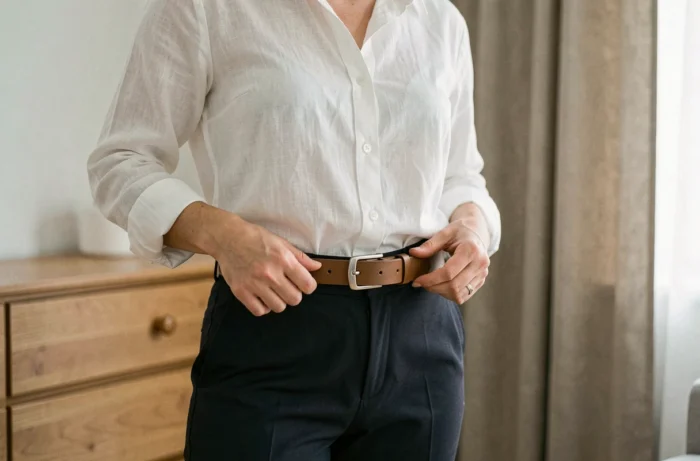
An overly long belt, a prong buckle that falls between two holes, a piece of leather sticking out of the loop: the problem is common, but the solutions vary greatly depending on the chosen mechanism. Automatic ratchet belt, sliding buckle, elastic strap, decorative knot – each holeless adjustment system relies on a distinct mechanical principle, with different trade-offs in terms of precision, durability, and compatibility with outfits.
Comparing Adjustment Mechanisms: Ratchet, Sliding, Elastic
The choice of a holeless belt is based on three families of mechanisms. Their differences are not just aesthetic: they determine the fineness of adjustment, the longevity of the strap, and the type of silhouette that can be complemented.
| Mechanism | Adjustment Precision | Common Width | Outfit Compatibility | Strap Durability |
|---|---|---|---|---|
| Ratchet | Click by click (a few millimeters) | Medium to wide | Jeans, dress pants | High (no perforation) |
| Sliding Buckle | Continuous (no clicks) | Narrow to medium | Dress, high-waisted, skirt | High |
| Woven Elastic | Continuous (stretching) | Narrow to medium | Jeans, casual outfit | Medium (loses elasticity) |
| Decorative Knot (no buckle) | Manual | Narrow | Dress, kimono, bohemian style | Variable depending on leather |
The ratchet system offers the finest adjustment precision among rigid mechanisms. The strap features a row of teeth on the back, invisible from the front. A lever integrated into the buckle releases the lock to adjust or remove the belt.
Finding the right solution for a women’s holeless belt depends as much on the mechanism as on the clothing context. A sliding buckle on fine leather works everywhere, while a wide ratchet is better suited for the loops of jeans.
The sliding buckle works by friction: a small metal lever pinches the smooth strap at any point. The precision is total, but the hold depends on the quality of the internal spring. On entry-level models, slippage can occur after a few months.

Leather, Strap, and Buckle: Criteria that Affect Longevity
The mechanism is not everything. The strap itself determines the longevity of the accessory and its behavior in daily use.
Thickness and Grain of the Leather
A full-grain leather strap retains its rigidity and appearance longer than a split leather covered with a film. On a holeless belt, this rigidity matters more: the strap must remain flat in the buckle mechanism, without curling or thinning at the tightening point.
Woven elastic belts circumvent this problem since they have no fixed friction point. However, elasticity decreases over time, especially if the belt remains constantly taut on a hanger or tightly rolled in a drawer.
Buckle Composition and REACH Regulation
Metal buckles in prolonged contact with the skin are subject to the European REACH regulation, which limits nickel migration. This constraint directly affects fine belts worn over a dress or at high waist, where the metal touches the abdomen.
Since December 2024, the GPSR regulation (EU 2023/988) requires online sellers to provide complete manufacturer contact details, a clear product identifier, and physical traceability on the packaging. For belt purchases on marketplaces, checking for these details on the product sheet is a reliable indicator of compliance.
- Manufacturer contact details (name, postal address, email) visible on the product sheet and packaging
- Product identifier: model number, lot, or series clearly displayed
- Technical file and risk assessment retained for ten years by the manufacturer
The absence of these mentions on a product sheet does not automatically indicate a health risk, but it does indicate a regulatory compliance issue.
Strap Width and Silhouette: What Style Imposes on the Mechanism
The width of the belt is not just an aesthetic choice. It determines which holeless mechanisms are available and how the accessory interacts with the garment’s cut.
A narrow belt (less than two centimeters) fits through the narrow loops of high-waisted pants or can be worn directly over a dress. At this width, the sliding buckle remains the most discreet mechanism, as the ratchet system requires a sufficient surface of teeth to hold, necessitating a minimum width.
Conversely, on jeans with wide loops, a three-centimeter automatic ratchet belt provides a sturdier adjustment than a sliding buckle, whose clamp can slip under tension on a wide and thick strap.

The choice becomes more complicated with intermediate outfits. A fluid pant worn at the waist can accommodate both systems, but a woven elastic belt adds extra comfort by moving with the body without creating folds in the fabric.
Adapting the Belt to the Garment, Not the Other Way Around
- Fluid or wrap dress: fine belt with sliding buckle, or a no-buckle model tied for a decorative effect
- Jeans or pants with standard loops: leather ratchet, medium width, simple buckle
- Dressy outfit (suit, pleated pants): smooth leather, flat sliding buckle, color matching the shoes
- Casual style: woven elastic, which tolerates size variations throughout the day
A common pitfall is buying a versatile holeless belt when two specialized belts better cover the entire wardrobe. A fine sliding and a medium ratchet are sufficient in most cases.
Maintenance and Lifespan According to the Mechanism
A well-designed ratchet works for several years without loss of precision, provided the unlocking lever is not forced. The weak point is the ratchet on the back of the strap: if it gets dirty or if the leather deforms, the teeth will no longer engage properly.
For sliding buckles, the internal spring is the critical element. Occasional cleaning of the mechanism with a dry cloth is enough to maintain friction. Avoid storing the belt folded at the buckle to preserve the shape of the leather in that area.
Elastic models have the shortest lifespan. Elasticity degrades with washing and heat. Storing them flat, without tension, extends their lifespan by a few additional seasons.
Ultimately, the choice of a holeless mechanism depends less on a single criterion than on the combination of the target garment, the suitable strap width, and the frequency of use. Two well-chosen belts will always better replace a single compromised belt.